
In Brief
Meeting someone from another community can challenge a stereotype, but proximity alone does not guarantee trust. Research on intergroup contact highlights the value of cooperation, shared goals, equal standing within the encounter and institutional support. Schools, housing and workplaces shape whether those conditions are available. Singapore's housing policy offers one example of organising proximity, with real practical trade-offs. The question is not simply whether different people occupy the same space, but whether they can participate, be heard and work together without humiliation or unequal burdens.
Detailed Story
Shared space can still contain barriers
People may live near one another while using separate schools, social networks or gathering places. An event can be formally open yet difficult to attend because of language, timing, cost, disability access or assumptions about food and worship. These examples illustrate how separation can persist without an explicit sign saying that someone is unwelcome.
A useful starting point is to examine an ordinary activity. Who receives the invitation? Who understands the language? Who can reach the venue? Who is expected to adapt? Such questions reveal whether a shared space actually offers a shared opportunity.
What contact research finds
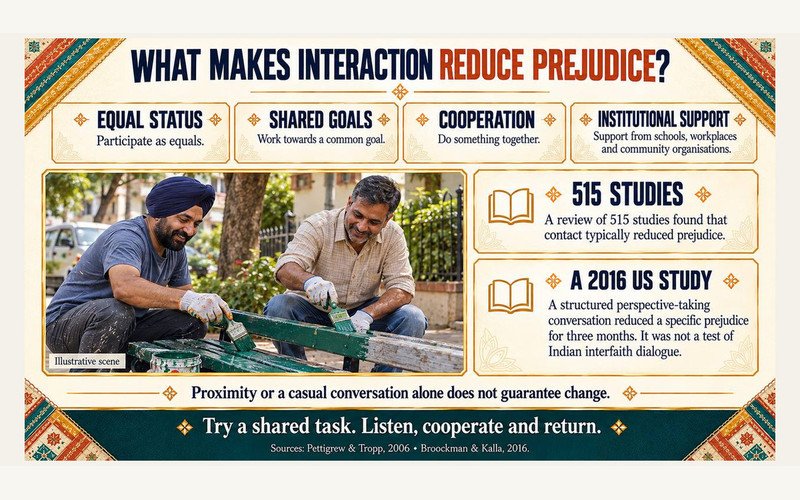
Thomas Pettigrew and Linda Tropp's 2006 meta-analysis brought together 515 studies and found that intergroup contact was generally associated with reduced prejudice. [1] The evidence covered different groups and settings; it was not a guarantee that any encounter would have the same effect.
The conditions associated with Gordon Allport's contact approach include equal status within the situation, common goals, cooperation and support from authorities or institutions. These are practical design principles, not a rigid checklist that makes success automatic. A school project in which pupils depend on one another's contributions differs from a meeting where one group is invited only to be questioned or judged.
Cooperation changes the encounter
A shared task creates information that a stereotype often suppresses: what a person knows, how they solve a problem and what matters to them. The task must be genuinely shared. If one participant always serves and another always decides, contact may reproduce the very hierarchy it was meant to challenge.
Institutional support matters because participants need confidence that harassment will be addressed. A friendly facilitator cannot compensate indefinitely for an organisation that tolerates exclusion. Repeated opportunities also allow a relationship to develop beyond the pressure of a single symbolic event.
What a brief conversation can and cannot establish
In a 2016 field experiment, David Broockman and Joshua Kalla studied doorstep conversations that encouraged perspective-taking about transgender people. They reported reductions in prejudice lasting at least three months. [2] This was a specific intervention, population and outcome. It does not prove that a ten-minute conversation will resolve every religious conflict.
Its relevance is the possibility of listening and reflection rather than argument alone. Its limits are equally instructive: interventions should be assessed by what they actually measure, and findings from one setting should be transferred cautiously to another.
Singapore's housing example
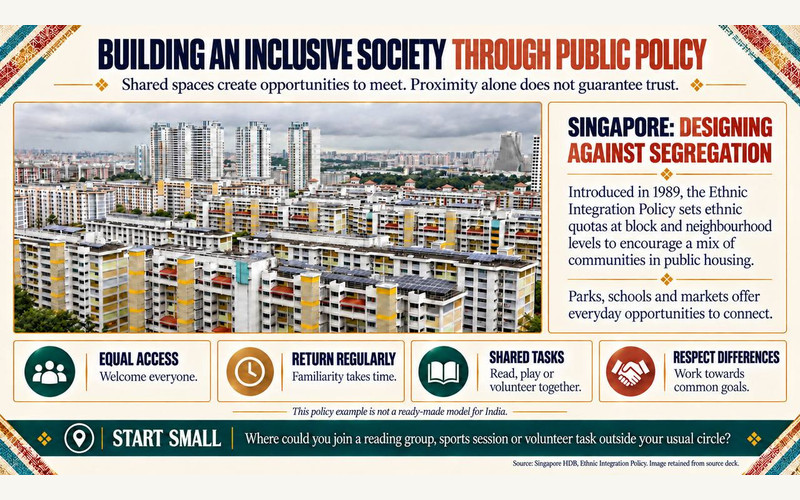
Singapore introduced the Housing and Development Board's Ethnic Integration Policy in 1989 to maintain an ethnic mix in public housing. [3] Quotas operate in the housing system, affecting eligibility for transactions in particular blocks and neighbourhoods. This is a policy about residential patterns, not a direct measurement of friendship.
The policy also creates trade-offs. Limits can restrict the pool of eligible resale buyers, and HDB describes assistance arrangements for affected owners. [4] A responsible account includes that burden alongside the aim of preventing enclaves. Singapore's ethnic categories and public-housing system also differ from India's; the scheme cannot simply be copied as a universal formula.
Make the next encounter useful
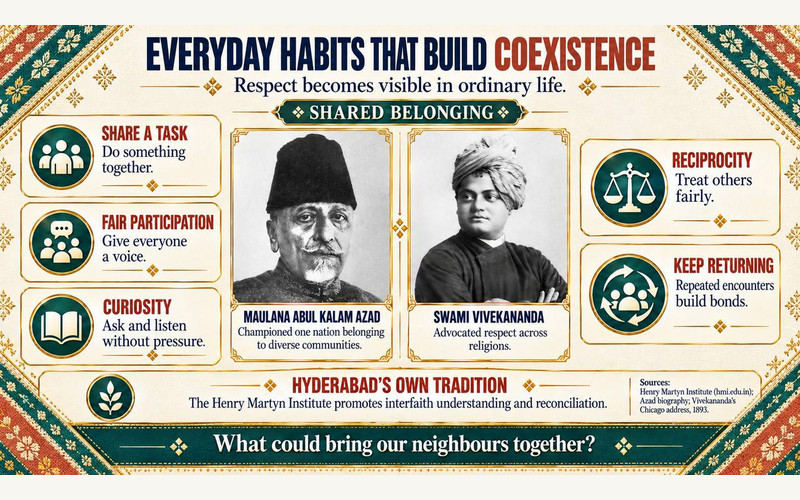
A neighbourhood clean-up, library activity or cooperative school assignment can provide a shared purpose. Clear participation rules, accessible arrangements and a way to raise concerns make the invitation more credible. The aim is not to turn every participant into a representative of their religion. It is to let people become known through ordinary, repeated interaction while institutions take responsibility for fair treatment.
Facts & Figures
Pettigrew and Tropp's 2006 meta-analysis covered 515 studies. [1]
Broockman and Kalla's 2016 experiment reported effects lasting at least three months in its specific setting. [2]
Singapore introduced its Ethnic Integration Policy in 1989. [3]
Important Distinction
Living close together is not the same as meaningful contact. Positive findings about contact also do not mean that unequal, threatening or humiliating encounters are beneficial.
Sources & Further Reading
1. Thomas F. Pettigrew and Linda R. Tropp. A Meta-Analytic Test of Intergroup Contact Theory, Journal of Personality and Social Psychology, 2006. https://doi.org/10.1037/0022-3514.90.5.751
2. David Broockman and Joshua Kalla. Durably reducing transphobia: A field experiment on door-to-door canvassing, Science, 2016. https://doi.org/10.1126/science.aad9713
3. Singapore Housing and Development Board. Our History, Ethnic Integration Policy entry. https://www.hdb.gov.sg/about-us/our-story/our-history
4. Singapore Housing and Development Board. Get Help: Ethnic Integration Policy or Singapore Permanent Resident Quota. https://www.hdb.gov.sg/check-ethnic-integration-policy-or-singapore-permanent-resident-quota/get-help
Related Topics
How prejudice develops and why group labels mislead