
In Brief
Dialogue becomes useful when people can ask real questions, hear different experiences and return to a relationship after disagreement. It is sustained by institutions, local associations and practical cooperation, not only public ceremonies. Hyderabad's Henry Martyn Institute and the gallery's examples of religious forums illustrate organised efforts to build such relationships. Their own descriptions establish what they aim to do; independent evidence is needed to measure results. Strong dialogue also makes room for people with less public authority, including women, young people and those whose experiences challenge a community's preferred account.
Detailed Story
Conversation has a purpose beyond agreement
An interfaith meeting need not end with participants accepting one another's theology. It may instead clarify a misunderstanding, establish a contact for future problems or identify an issue on which joint work is possible. A disagreement can be productive when participants understand what is actually disputed.
The gallery invokes figures such as Maulana Abul Kalam Azad and Vivekananda as part of India's history of engagement across religious difference. Their historical settings and positions were distinct. Rather than treating a famous name as proof that harmony already exists, the useful question is how contemporary organisations make sustained interaction possible.
A Hyderabad institution
The Henry Martyn Institute, based at Shivarampally in Hyderabad, describes its work in interfaith relations, research and reconciliation. Founded in 1930, it developed from a Christian institutional setting and now presents an explicitly interfaith educational mission. [1] Its location makes the gallery's subject concrete for Hyderabad readers: dialogue can be a local practice with a place, staff and continuing programmes.
An institution's account is a primary source for its history and stated activities, not an independent evaluation of its effectiveness. Readers should distinguish a documented programme from a demonstrated reduction in prejudice. Both information about activities and careful evaluation have value, but they answer different questions.
Religious forums and hosted encounters
Dharmik Jan Morcha reports a June 2024 round-table programme on justice in religious scriptures, organised with the Institute of Harmony and Peace Studies. [2] A shared theme such as justice can let participants explain their traditions while examining a public concern.
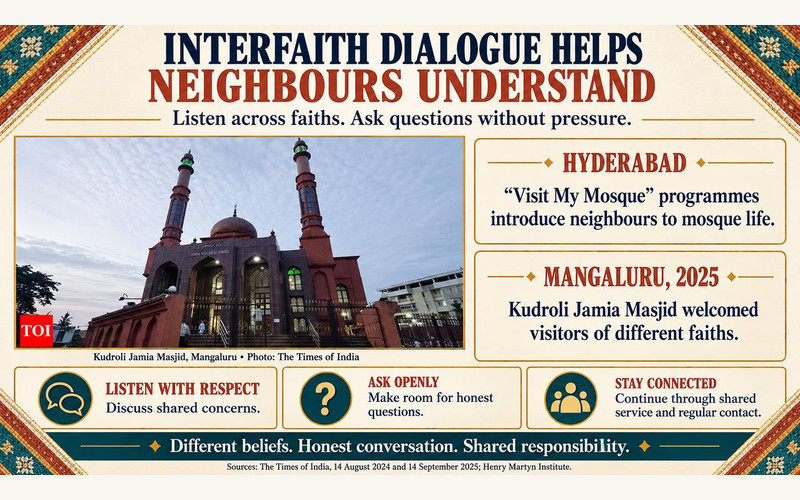
The gallery also discusses mosque visits and encounters in Hyderabad and Mangaluru. Such visits can offer direct conversation about worship and community life. They should be voluntary, clearly explained and open to questions. Hospitality is not consent to conversion, and participation should not require concealing disagreement. Illustrative photographs cannot by themselves establish who attended a specific event or what it achieved.
Associations can matter before a crisis
Ashutosh Varshney's research on Indian cities argues that networks connecting communities, especially organised civic associations, can help manage tensions and support peace. His 2002 study compares cities with differing experiences of communal violence. [3] This is a contextual historical argument, not a claim that any committee automatically prevents conflict.
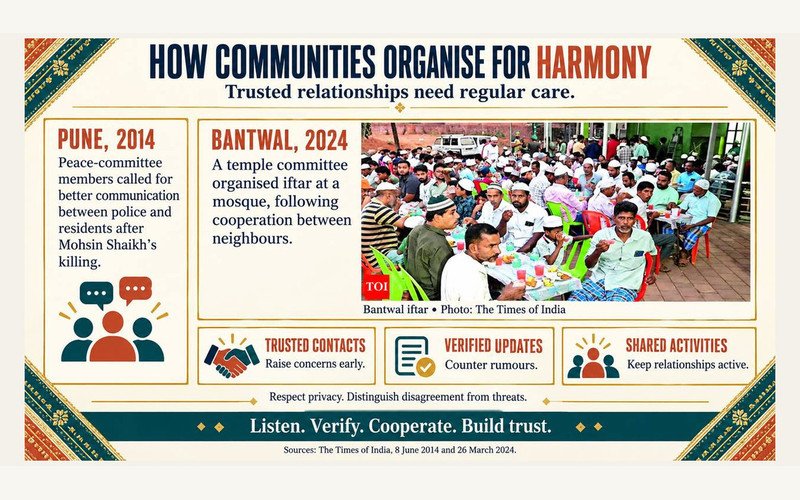
The gallery's Pune example points towards mohalla committees and local communication after the 2014 killing of Mohsin Shaikh. Contemporary reporting discussed the potential of active committees to reduce tension. [4] The operative word is active: names on a membership list do little if people have never established trust or a reliable way to share information.
Who gets to speak
A meeting consisting only of senior male religious leaders may miss experiences that matter to other members of the communities. Women, younger participants, people with disabilities and those with less social power may face different barriers. No single leader can describe every believer's life.
Good facilitation sets limits on personal attacks without forbidding difficult topics. Participants can distinguish criticism of an institution from contempt for a population and acknowledge a harm without being required to defend every person associated with their faith.
Sustaining the relationship
A useful outcome might be an agreed route for checking a rumour, a joint service activity or a regular forum where concerns can be raised before they escalate. Success should be assessed through concrete questions: who participated, whether excluded voices were heard, what changed and whether the relationship continued. Dialogue becomes credible when listening leads to accountable practice.
Important Distinction
Holding an interfaith event demonstrates that an event took place. It does not, without further evidence, establish that prejudice fell or a conflict was prevented.
Sources & Further Reading
1. Henry Martyn Institute. About HMI and institutional programme information. https://hmi.edu.in/about-hmi/ ; https://hmi.edu.in/extension-programs/
2. Dharmik Jan Morcha. Justice in Religious Scriptures, programme report dated 3 June 2024. https://dharmikjanmorcha.org/
3. Ashutosh Varshney. Ethnic Conflict and Civic Life: Hindus and Muslims in India, Yale University Press, 2002. https://www.jstor.org/stable/j.ctt1nq5hn
4. The Times of India. Mohalla committees can help if active: Khopade, June 2014. https://timesofindia.indiatimes.com/city/pune/mohalla-committees-can-help-if-active-khopade/articleshow/36226368.cms
5. Swami Vivekananda. Addresses at the Parliament of Religions, 1893; primary-text archive. https://www.ramakrishna.org/vivekanandaparliament.html
Related Topics
Shared ethical concerns across different traditions