
In Brief
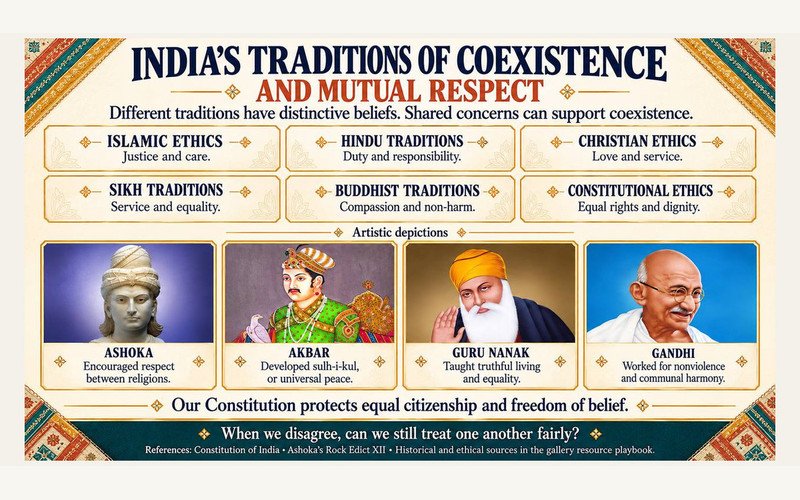
Different religious and secular traditions can support care, justice and restraint without becoming the same tradition. Their ideas arise from distinct texts, histories and practices, and their followers debate how to apply them. Ashoka's edicts, Akbar's political ideal of sulh-i kul, Sikh langar and modern interfaith engagement illustrate several approaches to living with difference. None proves that the society around it was perfectly equal. Shared civic work becomes more credible when people acknowledge both ethical common ground and the disagreements that remain.
Detailed Story
Agreement does not require sameness
A neighbour may help someone because of devotion to God, compassion, a commitment to human rights or a sense of reciprocal responsibility. People can cooperate in that action without agreeing on its ultimate justification. Interfaith work becomes strained when it demands that all traditions are secretly identical; it becomes superficial when it notices only pleasant similarities.
The Harvard Pluralism Project distinguishes active engagement with diversity from its mere presence. [1] In a plural society, people encounter differences, ask questions and build relationships while retaining convictions. This is more demanding than allowing separate communities to exist without meaningful contact.
Ashoka: restraint in speaking about others
The Mauryan emperor Ashoka's Major Rock Edict XII, from the third century BCE, addresses relations among religious communities. It commends restraint in praising one's own tradition and disparaging others, and encourages attention to other teachings. [2] The edict is a historical state inscription, not evidence that every subject or official followed its guidance.
Its continuing relevance lies in a recognisable communication problem: praise for one's own group can become a vehicle for contempt. A strong attachment to a tradition need not involve misrepresenting another. Historical translation and interpretation still matter; modern readers should not assume that ancient terms map perfectly onto today's categories of religion and citizenship.
Akbar: coexistence within an empire
The Mughal idea of sulh-i kul, often rendered as universal peace, is associated especially with Akbar's rule and the political thought of his court. NCERT's account discusses it as an ideal of relations across religious and ethnic groups. [3] It developed within a hierarchical monarchy, not a modern system of equal democratic citizenship.
That difference is important. A ruler's policy of accommodation can be historically significant without being credited with inventing tolerance or completing the work of equality. The useful comparison concerns how authority treats diversity, whose participation is permitted and what limits remain.
Sikh langar: equality practised through a meal
Langar, the communal meal associated with Sikh gurdwaras, brings service and sharing into a recurring practice. The Pluralism Project describes its significance for participation across social distinctions. [4] Its educational force comes from doing something together: preparing, serving, eating and cleaning.
An open meal is not proof that all social inequality disappears outside the dining space. It is a practice through which an ethical commitment can be expressed and renewed. Participants also need to understand local arrangements and behave respectfully rather than treating a living religious institution as a spectacle.
Modern voices and shared public work
Vivekananda's addresses at the 1893 Parliament of Religions articulated acceptance and challenged sectarian hostility from his own religious standpoint. [5] Gandhi's public life similarly connected religious conviction with nonviolent political action, although his views and methods remain subjects of historical debate. [6] Neither figure can stand for every Hindu interpretation or every Indian experience.
Christian service, Buddhist compassion, Islamic commitments to justice and secular commitments to equal rights offer further resources for cooperation. These descriptions identify broad ethical possibilities rather than uniform doctrines. The gallery's illustrations of historical figures should likewise be understood as representations, not authenticated portraits of an encounter among them.
The practical question is what people can undertake together while respecting difference: a shared meal, a neighbourhood response to danger, accurate information or a fair institutional rule. Cooperation gains depth when participants can also discuss power, exclusion and disagreement. Harmony does not require silence about injustice; it requires ways of addressing it without denying one another's dignity.
Facts & Figures
Ashoka's Major Rock Edict XII dates to the third century BCE. [2]
Akbar ruled from 1556 to 1605; sulh-i kul belonged to an imperial political setting. [3]
Vivekananda addressed the Parliament of Religions in Chicago in 1893. [5]
Important Distinction
Shared ethical concerns do not establish identical theology. An admirable historical ideal also does not prove that all institutions or practices of its period were inclusive.
Sources & Further Reading
1. Harvard University, Pluralism Project. Pluralism, institutional overview. https://pluralism.org/pluralism
2. Ashoka. Edicts, including Major Rock Edict XII; translation reproduced in Oregon State University's open textbook. https://open.oregonstate.education/ancientcivilizations/chapter/edicts-of-ashoka/
3. NCERT. Themes in Indian History, Part II, Kings and Chronicles, discussion of sulh-i kul; textbook reproduced by Philoid. https://philoid.com/ncert/chapter/lehs205
4. Harvard University, Pluralism Project. Langar: The Communal Meal. https://pluralism.org/langar-the-communal-meal
5. Swami Vivekananda. Addresses at the Parliament of Religions, 1893; Ramakrishna-Vivekananda Center archive. https://www.ramakrishna.org/vivekanandaparliament.html
6. Harvard University, Pluralism Project. Gandhi, Mohandas. https://pluralism.org/gandhi-mohandas
Related Topics
Human dignity justice and conscience in the Qur'an