
In Brief
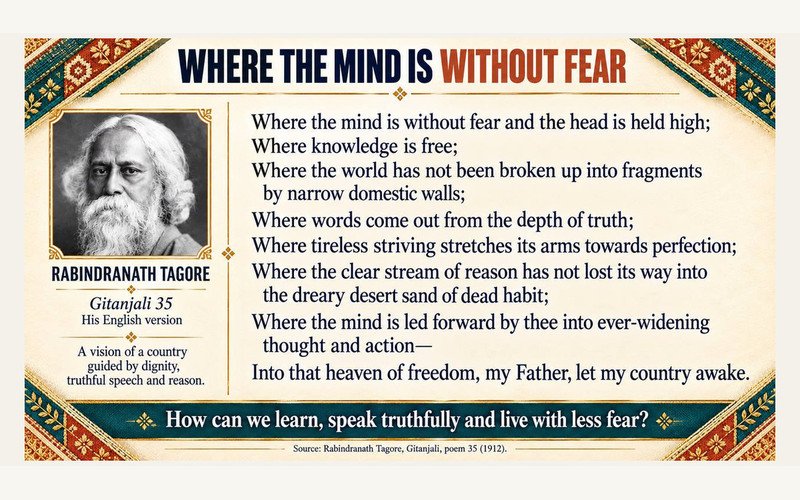
The gallery presents Rabindranath Tagore’s vision of a society in which people can learn, act and belong without fear. This article places his poem alongside the wider historical examples of Abdul Ghaffar Khan and A. P. J. Abdul Kalam. Tagore connects freedom with reason and openness; Ghaffar Khan organised disciplined nonviolent resistance; Kalam linked national aspiration with education and development. Reading these voices together requires attention to their different histories rather than treating them as a collection of interchangeable quotations.
Detailed Story
A poem about more than personal confidence
The English Gitanjali poem numbered 35 begins with an aspiration for a mind free from fear. Tagore connects that aspiration to knowledge, truthfulness, reason and a world not broken into narrow divisions. [1] The poem asks what conditions allow human capacities to develop; it is not merely encouragement to feel brave.
The English Gitanjali appeared in 1912, drawing on Tagore's Bengali poetry, and he received the Nobel Prize in Literature in 1913. Amartya Sen's discussion for the Nobel organisation places Tagore's thought within a wider concern for reason, freedom and cultural openness. [2] His international outlook should not be mistaken for indifference to India. It challenged the narrowing of human sympathy by rigid identities.
The gallery's use of the poem invites a civic reading: students should be able to ask questions, neighbours should not fear one another and loyalty should not require surrendering thought. Those are interpretations of its relevance, not additional lines attributed to the poet.
Ghaffar Khan: nonviolence as organised work
Abdul Ghaffar Khan, often known as Badshah Khan, developed the Khudai Khidmatgar movement among Pashtuns under British colonial rule. The movement's name means servants of God. It connected social reform, discipline and nonviolent resistance rather than treating courage as the ability to retaliate. [3]
The history is especially relevant because stereotypes can portray whole populations as naturally violent. An organised nonviolent movement among Pashtuns exposes the weakness of that assumption. Yet it should not be romanticised into a claim that every participant always acted perfectly or that nonviolence faced no internal and external difficulties.
The movement depended on training, organisation and the willingness to bear costs. That makes its example more demanding than a general appeal to be kind. It asks how institutions and shared commitments can sustain restraint when anger and pressure are strong.
Kalam: aspiration linked to opportunity
A.P.J. Abdul Kalam served as President of India from 2002 to 2007. In his public addresses, national development was connected with education, scientific capacity, public service and opportunities for young people. His presidential archive offers direct access to these themes. [4]
Kalam's presence in the gallery is not evidence that every citizen must achieve exceptional distinction to deserve belonging. His career is an example of participation in national life. Its broader educational significance is the importance of creating conditions in which many young people, across backgrounds, can develop their abilities.
Scientific achievement and moral aspiration also require different kinds of support. A hopeful speech does not prove that a particular policy works; scientific and social claims still need evidence. Openness to inquiry is part of the aspiration, not an obstacle to it.
Read the three voices together without merging them
Tagore was a poet and thinker, Ghaffar Khan an organiser of resistance, and Kalam a scientist and constitutional office-holder. Their historical roles and political settings differed. The gallery connects them through questions about courage, learning and shared public life, not through an invented meeting or common manifesto.
A society less governed by fear would make room for those differences. It would protect the ability to reason, encourage constructive participation and resist the reduction of people to inherited labels. The practical test is whether a child, neighbour or colleague can ask a question and pursue an opportunity without first concealing who they are.
Facts & Figures
English Gitanjali: 1912; Tagore's Nobel Prize in Literature: 1913. [1–2]
Khudai Khidmatgar emerged as an organised movement in the late 1920s. [3]
A.P.J. Abdul Kalam's presidential term: 2002–2007. [4]
Important Distinction
An inspirational text can express a moral vision; it does not supply empirical evidence that a particular intervention will achieve it. Historical figures should also be read as distinct people, not interchangeable symbols.
Sources & Further Reading
1. Rabindranath Tagore. Gitanjali, English poem 35, 1912; Tagore Web text archive. https://www.tagoreweb.in/Verses/gitanjali-190/where-the-mind-is-without-2850
2. Amartya Sen. Tagore and His India, 2001, Nobel Prize institutional website. https://www.nobelprize.org/prizes/literature/1913/tagore/article/
3. International Center on Nonviolent Conflict. The Khudai Khidmatgar (Servants of God) Movement: Badshah Khan and the Northwest Frontier of British India, historical case study. https://www.nonviolent-conflict.org/khudai-khidmatgar-servants-god-movement-badshah-khan-northwest-frontier-british-india-1933-1937/
4. President of India. Dr A.P.J. Abdul Kalam: Address to the Nation from the Ramparts of Red Fort, New Delhi, presidential speech archive. https://www.presidentofindia.gov.in/dr-apj-abdul-kalam/speeches/address-nation-ramparts-red-fort-new-delhi
Related Topics
Belonging citizenship and freedom of conscience