
In Brief
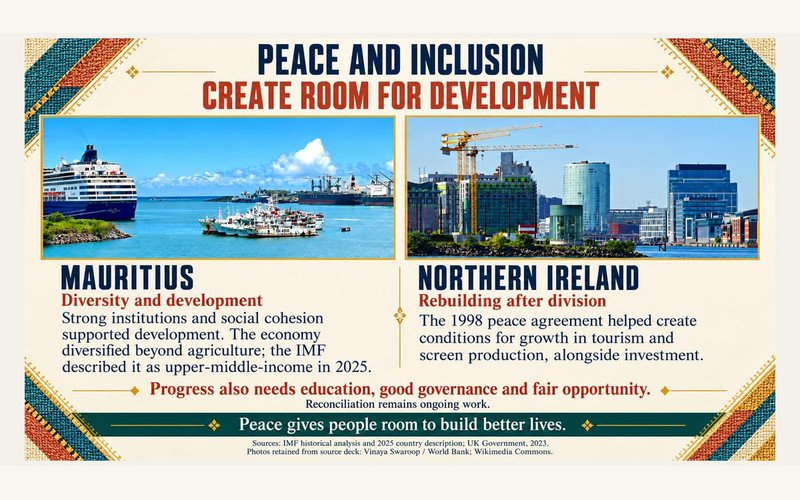
Peace can make education, investment and ordinary planning more secure, but it does not automatically produce prosperity. Mauritius and Northern Ireland illustrate different relationships between institutions, cooperation and economic opportunity. Their histories cannot be reduced to a single lesson or copied directly into India. Development also depends on policy, public services, accountability and the distribution of benefits. The gallery's closing vision is therefore a practical one: a better society expands people's ability to live safely, learn, work and participate without exclusion based on identity.
Detailed Story
Peace creates room for decisions
A business investment, a course of study or a move to a new neighbourhood involves expectations about the future. Violence makes those expectations uncertain. Reducing that uncertainty can release possibilities, but the opportunities still need institutions, resources and fair access.
The World Bank's work on conflict and development emphasises citizen security, justice and jobs as connected concerns. [1] A peace dividend is best understood as an opportunity to redirect attention and resources, not an automatic payment delivered when fighting stops. Different groups may experience the benefits unevenly.
Mauritius is a development history with several causes
Mauritius moved from heavy dependence on sugar towards a more diversified economy including manufacturing, tourism and services. The World Bank describes both this transformation and the challenges of sustaining productivity and opportunity. [2] Its religious and ethnic diversity makes it a relevant gallery example, but diversity alone explains neither success nor failure.
Policy decisions, trade relationships, institutions, education and investment all require consideration. Describing Mauritius as prosperous simply because people are harmonious would turn a complex history into an untested causal claim. Nor does national economic progress establish that every resident enjoys equal opportunities.
A recent World Bank and IFC private-sector diagnostic identifies constraints and opportunities for an economy seeking more innovation-led growth. [3] This reminds readers that a relative success story remains unfinished. Development requires continuing adaptation rather than permanent confidence in a past formula.
Northern Ireland and an institutional peace process
The Belfast, or Good Friday, Agreement was reached on 10 April 1998. It established a framework involving power-sharing, rights, the principle of consent and cooperation across political boundaries. The official agreement text is the primary source for understanding its commitments. [4]
The agreement's importance is not that it made historical identities disappear. It created arrangements through which people with conflicting constitutional aspirations could pursue them by democratic and peaceful means. That institutional design is different from asking everyone to feel the same way about the past.
Improved security created scope for investment, travel and ordinary activity. Yet economic change also reflects wider UK, Irish and global conditions. A responsible comparison does not attribute every later employment figure or new business to the agreement alone. Political disputes and social separation likewise show why a settlement must be sustained rather than merely commemorated.
Different histories offer different lessons
Mauritius is not a post-conflict model identical to Northern Ireland, and neither is a simple counterpart to India. The useful comparison concerns mechanisms: predictable rules, credible institutions, cooperation and opportunities for participation. It also concerns limits: growth can coexist with exclusion, and a peace agreement can coexist with unresolved grievances.
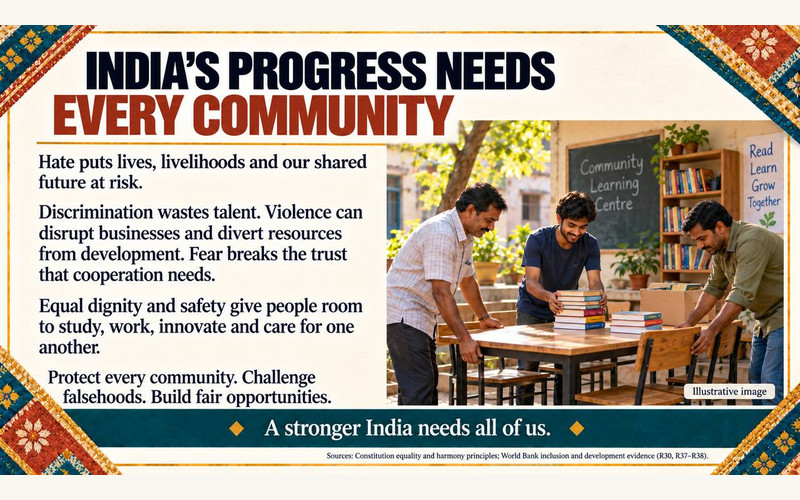
India's scale, federal structure, social inequalities and local histories require their own analysis. The gallery's examples should encourage questions rather than supply a ready-made policy package. Which barriers prevent children from learning? Which public services are unreliable? Can disputes be addressed fairly before people turn to intimidation?
Make the vision measurable without narrowing it
A better India would be assessed through people's actual conditions: safety, access to education and healthcare, fair opportunities to work, and confidence that institutions will hear them. The World Bank's social-inclusion framework adds attention to dignity and participation, not only income. [5]
Economic measures matter, but no growth rate can excuse the routine humiliation of a minority or the silencing of a vulnerable person. The closing invitation is to connect a broad aspiration with specific responsibilities: accurate information, fair institutional rules and cooperation that lasts beyond a public event. Peace opens possibilities when people can use it to build lives with one another.
Facts & Figures
Belfast / Good Friday Agreement: 10 April 1998. [4]
The agreement provides for institutions and cooperation across several political relationships; it is not simply a ceasefire declaration. [4]
World Development Report 2011 links security, justice and jobs in its account of conflict and development. [1]
Important Distinction
A favourable outcome after a peace initiative is not proof that the initiative alone caused it. Economic growth, social inclusion and reconciliation are related but distinct outcomes.
Sources & Further Reading
1. World Bank. World Development Report 2011: Conflict, Security, and Development. https://documents1.worldbank.org/curated/en/966731468161352341/pdf/World-development-report-2011-conflict-security-and-development.pdf
2. World Bank. Mauritius country overview, consulted 5 October 2026. https://www.worldbank.org/ext/en/country/mauritius
3. World Bank and International Finance Corporation. Mauritius Country Private Sector Diagnostic: Increasing Private Sector Participation in an Innovation-Led Economy. https://www.worldbank.org/en/country/mauritius/publication/mauritius-afe-cpsd-increasing-private-sector-participation-in-an-innovation-led-economy
4. UK Government. The Belfast Agreement, agreement of 10 April 1998, official text. https://www.gov.uk/government/publications/the-belfast-agreement
5. World Bank. Inclusion Matters: The Foundation for Shared Prosperity, 2013. https://documents.worldbank.org/curated/en/384801468326712492/pdf/817480WP0Inclu0Box0379844B00PUBLIC0.pdf
Related Topics
The human and economic costs of exclusion