
In Brief
Sri Lanka's civil war, conventionally dated from 1983 to 2009, shows how prolonged conflict can damage lives, institutions and economic possibilities. Its causes and conduct cannot be reduced to a simple story of neighbours disliking one another. Political exclusion, competing nationalisms, armed organisations and state responses all shaped the conflict. The end of fighting created opportunities for reconstruction, but recovery required more than military victory. A peace dividend is a possibility created by improved security; justice, public trust and sound economic choices help determine whether it lasts.
Detailed Story
A conflict needs historical specificity
Sri Lanka's war involved the state and the Liberation Tigers of Tamil Eelam, alongside other actors and changing political circumstances. Tamil demands and armed separatism emerged within a longer history of disputes over citizenship, language, education, representation and the distribution of power. Reducing the war to a timeless hostility between religions would conceal those political developments.
The year 1983 is commonly used as the starting point of the civil war, following anti-Tamil violence known as Black July; the armed conflict ended in 2009. The suffering included civilians from several communities, displacement and serious abuses. The UN's 2011 Panel of Experts examined allegations concerning the final stages of the war, identifying credible allegations against both government forces and the LTTE that warranted further investigation. [1] Allegations, established findings and estimates must be kept distinct.
Costs extend beyond destroyed buildings
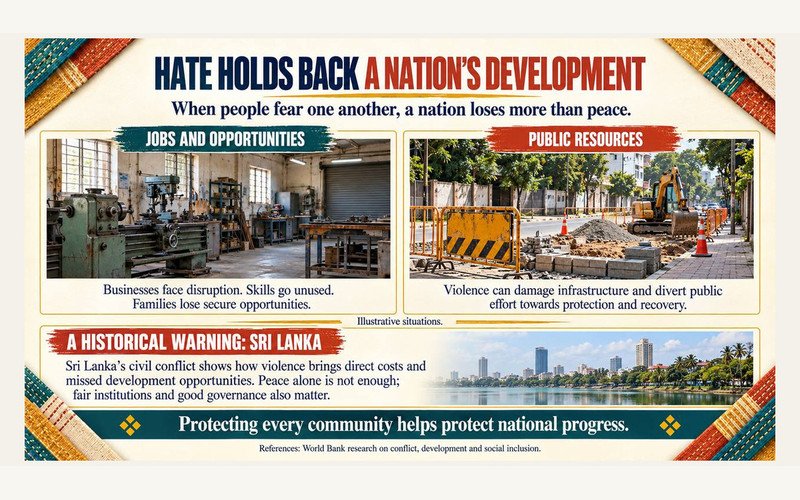
Conflict disrupts decisions that depend on confidence in the future. A family may postpone schooling or move repeatedly. A business may avoid an investment whose staff, supplies or property cannot be kept secure. Public resources may be diverted from civilian needs, while damaged infrastructure can interrupt markets and services.
These are mechanisms, not a claim that every economic problem in Sri Lanka had the same cause. Weather, global demand, policy decisions and domestic institutions also influence outcomes. The World Bank's World Development Report 2011 analyses the relationship between insecurity, institutional weakness and development, emphasising the importance of citizen security, justice and jobs. [2]
What growth after war does and does not show
A World Bank South Asia economic assessment reported average Sri Lankan growth of about 7.5% during 2010–2013. [3] Reconstruction and improved security helped create opportunities after the war. But a before-and-after comparison cannot isolate peace as the sole cause: investment, borrowing, policy choices and wider economic conditions were also involved.
An early recovery rate is not a guarantee of durable prosperity. It can partly reflect rebuilding from a damaged base. Assessing progress therefore requires more than one headline growth number. Who gained access to work? Were displaced people able to rebuild their lives? Did public institutions become more accountable? Were the benefits and costs distributed fairly?
Reconciliation cannot be assumed
The end of organised fighting does not automatically resolve missing-person cases, property disputes, mistrust or demands for political representation. People may experience an officially peaceful environment very differently depending on their location, history and relationship with state institutions.
The UN panel's work also demonstrates why documentation and accountability remain important after a war. Recognising civilian suffering is not a competition in which acknowledging one community's loss cancels another's. Claims about particular perpetrators require evidence; communities cannot be assigned inherited guilt.
What the comparison offers India
Sri Lanka is not a prediction of India's future, and the two societies should not be treated as interchangeable. The comparison is useful at the level of prevention: protect equal citizenship, address grievances through credible institutions and resist narratives that turn whole populations into enemies.
Peace supports ordinary planning when people expect disputes to be addressed without violence. Sustaining that expectation requires schools, courts, public services, political participation and accurate public information. The gallery's development argument is strongest when expressed this way: reducing violence can open opportunities, while inclusive and accountable institutions help people use them.
Facts & Figures
Conventional civil-war dates: 1983–2009. [1]
UN Secretary-General's Panel of Experts report on accountability: 2011. [1]
World Bank assessment: average economic growth of about 7.5% in 2010–2013; this is a historical period, not a current rate. [3]
Important Distinction
The absence of war is not the same as reconciliation, and post-war growth does not prove that every underlying grievance has been resolved.
Sources & Further Reading
1. United Nations. Report of the Secretary-General's Panel of Experts on Accountability in Sri Lanka, 2011. https://www.un.org/News/dh/infocus/Sri_Lanka/POE_Report_Full.pdf ; official release and findings: https://press.un.org/en/2011/sgsm13524.doc.htm
2. World Bank. World Development Report 2011: Conflict, Security, and Development. https://documents1.worldbank.org/curated/en/966731468161352341/pdf/World-development-report-2011-conflict-security-and-development.pdf
3. World Bank. South Asia Economic Focus: Making the Most of Cheap Oil, Spring 2015, Sri Lanka discussion, printed page 61. https://www.worldbank.org/content/dam/Worldbank/document/SAR/saef-final.pdf
Related Topics
Learning from histories of organised hate