

In Brief
National belonging does not require every citizen to express affection for the country in the same way. Religious identity, conscientious belief and Indian citizenship can coexist. The Constitution protects equality, expression and conscience while recognising civic responsibilities. A Supreme Court case involving Jehovah's Witness schoolchildren illustrates why respectful non-participation cannot automatically be treated as disloyalty. Surveys can describe national pride, but rights are not prizes awarded for giving popular answers. People belong as citizens, not because their community has passed a recurring test of loyalty.
Detailed Story
Shared citizenship allows different identities
A person can identify with a neighbourhood, language, state, religion and country at the same time. These attachments need not compete. Religious communities also cross national borders without making every member politically answerable for foreign governments or organisations.
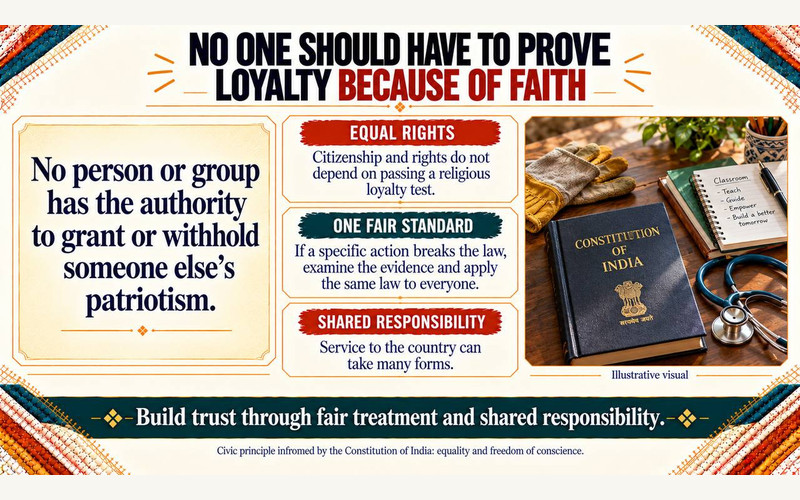
Treating Muslims, or any other Indian religious community, as presumptively foreign confuses faith with nationality. It also shifts the burden unfairly: instead of examining an individual's conduct, the demand becomes that an entire population repeatedly prove its belonging. Constitutional equality provides a different starting point. Articles 14 and 15 address equality and prohibited discrimination, while other provisions protect expression and conscience. [1]
The national anthem case
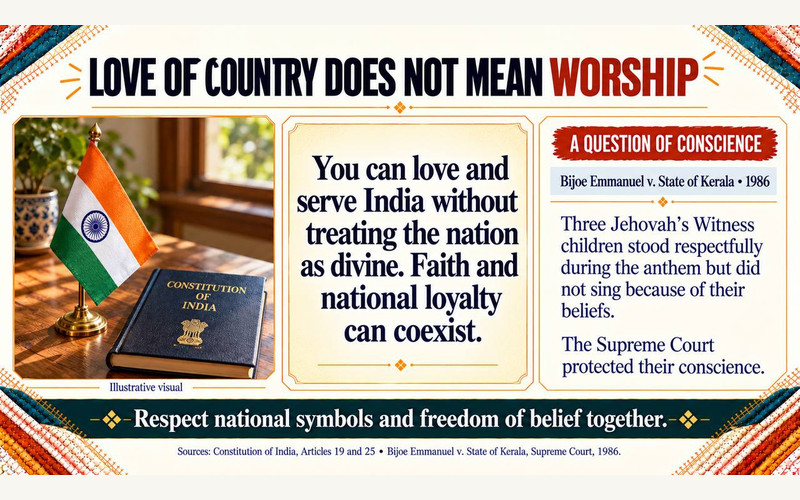
In Bijoe Emmanuel v. State of Kerala, decided in 1986, the Supreme Court considered the expulsion of three Jehovah's Witness schoolchildren who stood respectfully during the national anthem but did not sing because of their religious conviction. The Court protected their rights under Articles 19(1)(a) and 25. [2]
The details matter. The children were not disrupting the anthem or preventing others from singing. Their respectful conduct and sincerely held belief were central to the case. The judgment does not mean that every action involving a national symbol is legally identical. It demonstrates that a visible difference in participation can require understanding rather than an instant accusation of disloyalty.
The case concerned Christian children, making the principle wider than any dispute about Muslims. Freedom of conscience is tested most clearly when the majority does not share the conviction being protected.
Love of country and worship
Some believers distinguish civic affection from acts they regard as worship. They may willingly serve their neighbours and respect national institutions while declining a particular religiously significant gesture. Other believers interpret the same gesture differently. There is no single response shared by every member of a faith.
A useful conversation therefore asks what a person means and what they are actually doing. It should not presume that refusal of a phrase or ritual equals rejection of fellow citizens. Equally, a person cannot infer someone else's theology merely from their participation in a civic ceremony. Intent, conduct and context all matter.
What national-pride surveys tell us
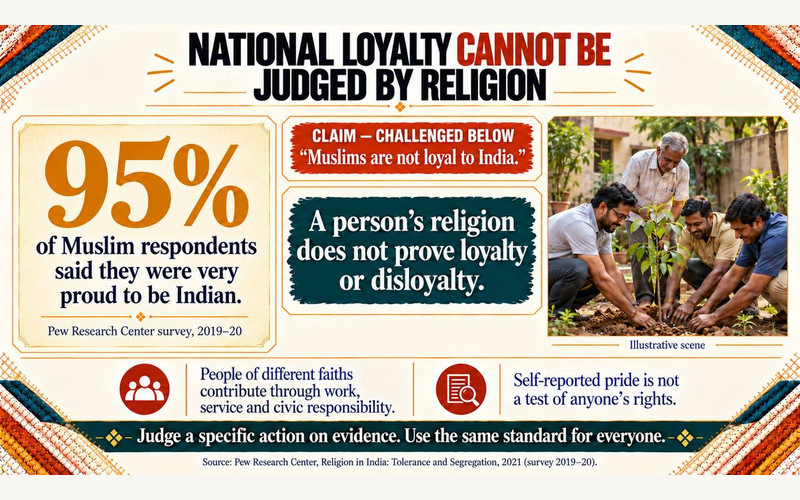
Pew’s 2019–2020 survey found that 95% of Muslim respondents said they were very proud to be Indian. [3] In a separate question, 91% of Muslim respondents said respecting India was very important to what being Muslim meant to them. [4] These are reported attitudes from a dated survey, not psychological tests of every citizen.
The findings counter a simple assumption that Muslim religious identity necessarily conflicts with attachment to India. But constitutional belonging does not depend on these figures being high. People retain rights when they criticise government policy, disagree with prevailing opinion or express disappointment in public institutions through lawful means.
Ordinary participation counts
National life depends on work that rarely becomes a headline: teaching, farming, caregiving, transport, research, sanitation and neighbourhood cooperation. Celebrated service can inspire, but exceptional achievement should not become the price a minority must pay for acceptance.
A fair public culture applies the same evidentiary standard to everyone. It examines misconduct specifically, recognises conscientious difference and allows disagreement about what best serves the country. Belonging becomes secure when people can contribute and question without first defending the legitimacy of their presence.
Facts & Figures
Bijoe Emmanuel v. State of Kerala was decided on 11 August 1986. [2]
Pew’s 2019–2020 survey: 95% of Muslim respondents reported being very proud to be Indian. [3]
In the same survey, 91% of Muslims considered respecting India very important to their Muslim identity. [4]
Important Distinction
A citizen's criticism of a government is not automatically rejection of the country. Respect for a national symbol and participation in a particular ritual are also not always identical legal or conscientious questions.
Sources & Further Reading
1. Government of India. Constitution of India, 2024 edition, Articles 14, 15, 19, 25 and 51A. https://lddashboard.legislative.gov.in/sites/default/files/coi/COI_2024.pdf
2. Supreme Court of India. Bijoe Emmanuel v. State of Kerala, 1986; judgment reproduced by Indian Kanoon. https://indiankanoon.org/doc/1508089/
3. Pew Research Center. Nationalism and politics, 2021. https://www.pewresearch.org/religion/2021/06/29/nationalism-and-politics/
4. Pew Research Center. Religious identity, 2021. https://www.pewresearch.org/religion/2021/06/29/religious-identity-2/
Related Topics
Freedom of conscience and claims about conversion