
In Brief
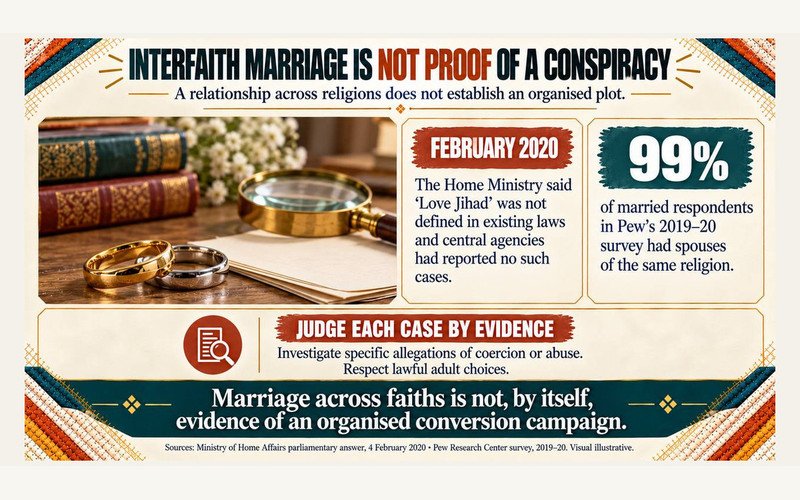
An interfaith relationship is not evidence of a conspiracy. Adults may choose partners across religious boundaries, while any allegation of coercion or deception must be assessed on its own evidence. The expression “love jihad” is a political and public label, not a reliable substitute for identifying a specific offence. A 2020 parliamentary answer addressed the term and central-agency records within a stated context; it did not establish what happened in every relationship. The most important distinction is between protecting an adult's freedom and assuming that the adult cannot choose freely.
Detailed Story
A label can decide the story before the evidence
The gallery rejects a narrative that portrays interfaith relationships involving Muslim men as a coordinated threat. The distinction between group suspicion and evidence about individuals is crucial. A religious difference between partners does not demonstrate an organised scheme. At the same time, no general statement can establish that every relationship is free from abuse, fraud or pressure.
The proper unit of investigation is the alleged conduct. Who is said to have done what, when and with what evidence? A broad label can obscure these questions by replacing them with suspicion directed at a community. It can also prevent the adult most affected from being heard as a decision-maker.
Read the parliamentary answer in its actual scope
On 4 February 2020, the Ministry of Home Affairs told the Lok Sabha that the term “love jihad” was not defined under the then-existing laws and that central agencies had reported no such case. The answer also referred to two interfaith-marriage cases in Kerala investigated by the National Investigation Agency. [1]
This was an answer to a particular parliamentary question, including a Kerala-related context. It is not a permanent finding about all agencies, all jurisdictions or every subsequent case. Its significance is that an emotive public expression must not be mistaken for a self-explanatory legal category. Claims should identify the applicable law and the underlying evidence instead.
The significance of Hadiya's case
The Supreme Court's 2018 judgment in Shafin Jahan v. Asokan K.M. concerned the annulment of the marriage of Hadiya, an adult woman. The Court restored the marriage and addressed the importance of individual autonomy. [2] A relationship did not become the court's to choose because others questioned it.
This distinction leaves room to investigate a specific crime. Restoring an adult's marriage and deciding whether a separate offence occurred are different legal tasks. The judgment is therefore relevant both to liberty and to evidentiary discipline: family anxiety or public controversy cannot themselves establish criminal conduct.
Interfaith marriage is uncommon, but rights do not depend on numbers
In Pew's 2019–2020 survey, about 99% of married Indian respondents reported a spouse of the same religion. [3] The figure describes the survey's married respondents and their reported present affiliations. It is not a count of every marriage registered in India, nor does it reveal the complete religious history of each couple.
Rarity does not make a relationship illegitimate. Nor does it prove that every uncommon relationship must have an extraordinary hidden cause. Many people meet through education, work or friendship and make choices that differ from family expectations. Their legal protection does not depend on how frequently others make the same choice.
Protection requires listening without presuming
A person may need help because of partner violence, family threats or harassment by outsiders. The direction of coercion should not be assumed in advance. An inquiry that hears only relatives or public campaigners may miss the adult's own account. Conversely, treating every complaint as politically motivated could neglect someone facing real harm.
A sound response separates consent, age, allegations of criminal conduct and the person's immediate safety. It avoids exposing private details to a crowd and resists pressure to turn a personal relationship into evidence about an entire religion. These principles apply across the genders and religious identities of the people involved.
The public conversation improves when it moves from slogans to specific, answerable questions. Was there a freely expressed choice? What evidence supports any allegation? What did the court actually decide? Those questions protect both accountability and the possibility of ordinary life across religious boundaries.
Facts & Figures
The cited Ministry of Home Affairs parliamentary answer is dated 4 February 2020. [1]
Hadiya's marriage was restored by the Supreme Court in 2018. [2]
Approximately 99% of married respondents in Pew's 2019–2020 India survey reported a same-religion spouse. [3]
Important Distinction
“No evidence supplied for a conspiracy” does not mean “no individual offence is possible.” Equally, an allegation involving one couple does not establish a community-wide conspiracy.
Sources & Further Reading
1. Ministry of Home Affairs. Lok Sabha Starred Question No. 23 and answer, 4 February 2020. https://www.mha.gov.in/MHA1/Par2017/pdfs/par2020-pdfs/ls-04022020/23.pdf
2. Supreme Court of India. Shafin Jahan v. Asokan K.M., 2018. https://api.sci.gov.in/supremecourt/2017/19702/19702_2017_Judgement_08-Mar-2018.pdf
3. Pew Research Center. Religious segregation, 2021, findings from 2019–2020 fieldwork. https://www.pewresearch.org/religion/2021/06/29/religious-segregation/
Related Topics
Freedom of conscience and claims about conversion