
In Brief
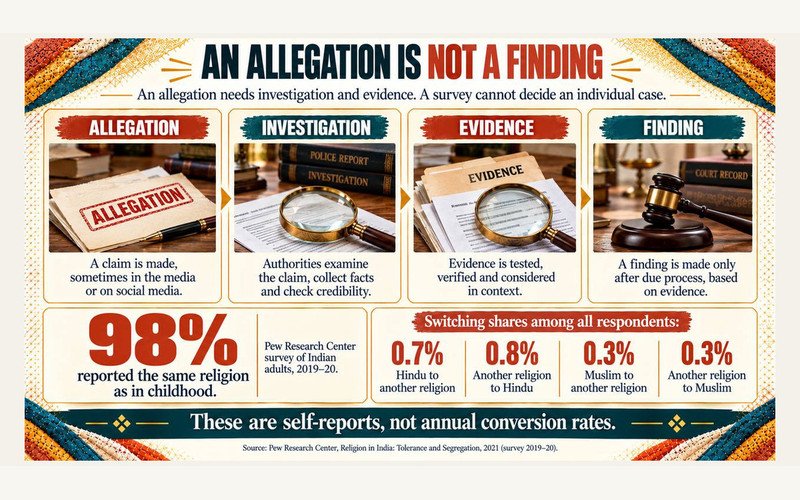
Freedom of conscience protects a person's capacity to hold and consider beliefs. It also requires attention to coercion: threats, deception and violence cannot be dismissed as religious freedom. India's constitutional framework and court decisions distinguish personal choice from unlawful conduct. Claims of mass religious switching require demographic evidence, while an allegation about a particular conversion requires investigation of that case. Neither a survey nor a slogan can decide whether an individual acted freely. Adults' own accounts and the applicable legal standards must remain central.
Detailed Story
Begin with the person whose belief is at issue
Religion may be inherited, reconsidered, practised differently or left behind. Some people adopt another tradition; others change their interpretation within the same one. These experiences are not interchangeable. A census category or survey answer captures only part of a person's religious life.
The gallery's essential question is how to preserve both freedom of belief and freedom from force. Those principles belong together. A person should not be coerced into changing religion, and concern about coercion should not become a licence to deny an adult's independently expressed choice.
What Article 25 protects
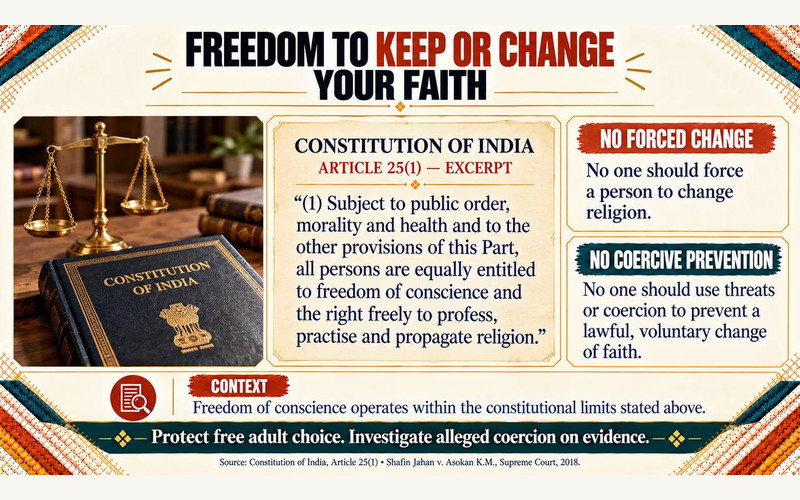
Article 25 of India's Constitution recognises freedom of conscience and the right freely to profess, practise and propagate religion, subject to public order, morality, health and the other provisions of Part III. [1] The qualifications matter, but so does the freedom itself. The provision is not a promise that every action described as religious is exempt from law.
In Rev. Stainislaus v. State of Madhya Pradesh in 1977, the Supreme Court upheld the challenged state provisions against conversion by force, fraud or inducement and distinguished propagation from a right to convert another person. [2] That ruling should be read alongside, rather than used to erase, the individual's own freedom of conscience. Its reasoning and the wording of particular laws require careful attention.
Adult choice and the courts
In Shafin Jahan v. Asokan K.M. in 2018, concerning Hadiya's marriage, the Supreme Court restored the marriage set aside by the Kerala High Court and emphasised the autonomy of an adult in intimate decisions. [3] Investigation of an alleged offence and judicial substitution of a parent's or court's preference for an adult's marriage choice are different matters.
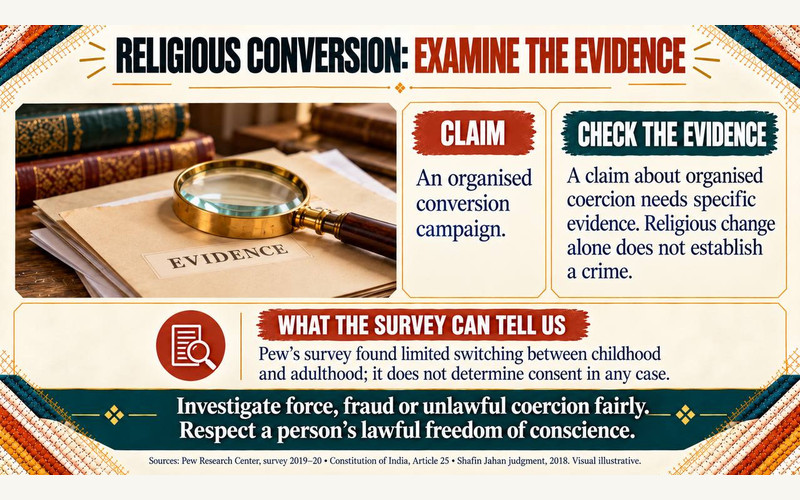
The case does not certify that no coercion ever occurs in religious relationships. It establishes why an adult's agency cannot disappear merely because a family objects to their religion or partner. A fair inquiry distinguishes the person's account, the evidence of any alleged offence and the legal question actually before the court.
What survey evidence can establish
Pew Research Center's survey of 29,999 Indian adults, conducted in 2019–2020, found that approximately 98% identified with the religion in which they were raised. [4] This suggests that religious switching was uncommon in that survey. It does not measure every conversion event, reconstruct the motives of every respondent or investigate coercion.
The survey compares reported upbringing with reported present affiliation. Someone may have changed beliefs without changing the survey category; someone may also have changed affiliation more than once. Small percentages must be interpreted with sampling limitations in mind. They cannot support a claim that conversion never happens, just as isolated reports cannot establish a nationwide demographic transformation.
Evaluate allegations on their evidence
When a story alleges coercive conversion, ask what conduct is alleged, whose testimony is available, whether a complaint has become a charge and whether a court has made findings. Distinguish a person's chosen change of belief from threats, confinement, deception or exploitation. Avoid publishing identifying details that expose someone to harassment without advancing a legitimate evidentiary purpose.
State laws and litigation differ and can change; the constitutional discussion here does not attempt to provide a current procedural guide for each jurisdiction. The durable lesson is that protection is meaningful only when it protects the person concerned. It must neither excuse coercion nor presume that an unpopular choice is necessarily coerced.
Facts & Figures
Article 25 sets out freedom of conscience and religious profession, practice and propagation, with specified qualifications. [1]
Rev. Stainislaus: Supreme Court decision, 1977. [2]
Shafin Jahan: Supreme Court decision restoring the marriage, 2018. [3]
Pew's 2019–2020 survey: approximately 98% retained their childhood religious affiliation. [4]
Important Distinction
The right to make one's own religious choice is different from a claimed right to impose a choice on someone else. An allegation of coercion is also different from a finding that coercion occurred.
Sources & Further Reading
1. Government of India, Legislative Department. Constitution of India, 2024 edition, Article 25. https://lddashboard.legislative.gov.in/sites/default/files/coi/COI_2024.pdf
2. Supreme Court of India. Rev. Stainislaus v. State of Madhya Pradesh, 1977; judgment reproduced by Indian Kanoon. https://indiankanoon.org/doc/1308071/
3. Supreme Court of India. Shafin Jahan v. Asokan K.M., 2018. https://api.sci.gov.in/supremecourt/2017/19702/19702_2017_Judgement_08-Mar-2018.pdf
4. Pew Research Center. Religion in India: Tolerance and Segregation, 2021, survey overview and religious switching findings. https://www.pewresearch.org/religion/2021/06/29/religion-in-india-tolerance-and-segregation/
Related Topics
Interfaith relationships autonomy and allegations