
In Brief
Care can take the form of immediate protection, practical assistance, teaching or sustained legal work. The gallery places these different actions beside one another to show that responsibility is not confined to public officials or religious leaders. Its named examples need to be read in their own contexts, with reported events distinguished from self-descriptions and advocacy. No individual is a flawless symbol or a representative of an entire community. The useful question is what a particular action did for someone facing danger, exclusion or an unmet need.
Detailed Story
Practical help during a crisis
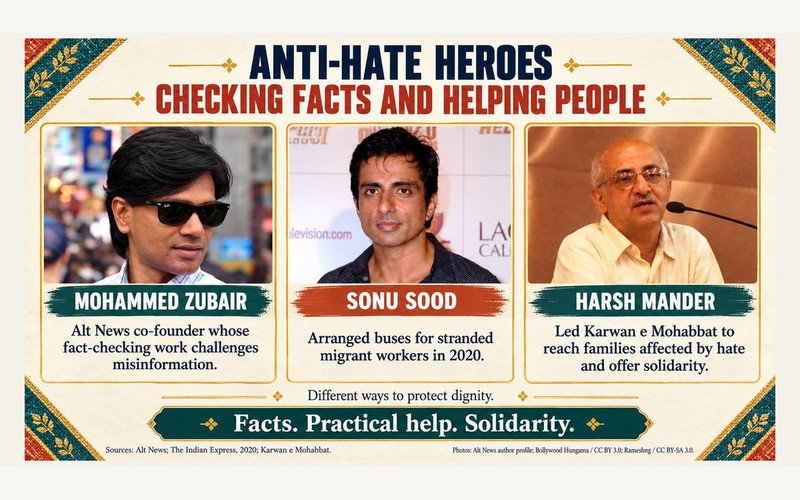
In May 2020, reporting described actor Sonu Sood arranging buses for stranded migrant workers travelling from Mumbai to Karnataka during the COVID-19 lockdown. [1] Transport was a concrete response to a concrete obstacle. It did not resolve the broader policy and labour conditions that had left migrants vulnerable.
Witnessing and accompanying
Harsh Mander described Karwan-e-Mohabbat in 2017 as a journey to meet families affected by hate violence and respond through solidarity and public witness. [2] This is an account by an organiser and therefore a source for the initiative's purpose, not a neutral evaluation of every claim made in its advocacy.
Accompaniment can matter after attention moves elsewhere: listening, helping someone navigate services and refusing to let a victim become only a statistic. But meaningful support also requires consent. A family may need privacy or practical assistance more than publicity. Care should be shaped by the affected person's needs rather than the helper's wish to appear courageous.
Speaking and teaching
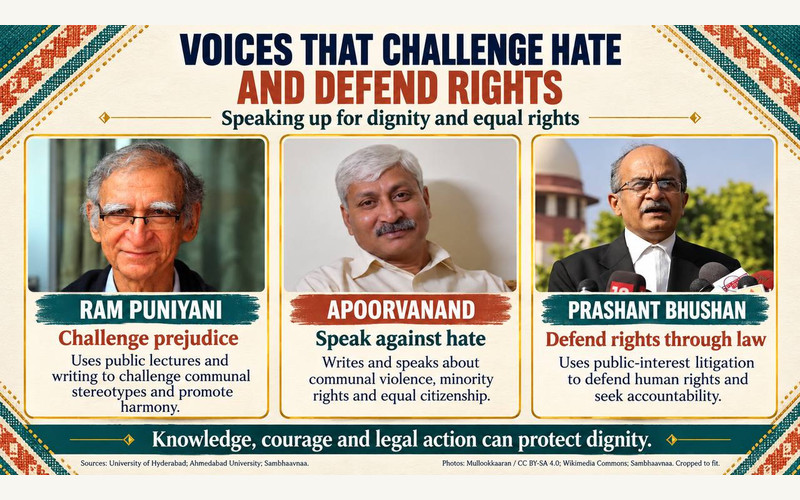
The gallery names Ram Puniyani and Apoorvanand as public voices against prejudice. Puniyani's published writing addresses communalism and secularism; Apoorvanand is a scholar associated with the University of Delhi's Department of Hindi and participates in public debate. [3–4] Their arguments can be examined and challenged on their evidence. Recognising the role of public education does not require agreement with every position they take.
Teaching can make a contribution by slowing a debate down: defining a term, recovering historical context or showing that a widely repeated claim has weak support. The standard should remain consistent even when the conclusion is politically inconvenient.
Law as sustained work
Prashant Bhushan's institutional biography describes his work in public-interest litigation and the Campaign for Judicial Accountability and Reforms. [5] Legal advocacy differs from a court's decision. A petition presents arguments and requests remedies; the court determines the matter within its jurisdiction.
That distinction helps readers appreciate the work without treating an advocate's involvement as proof that every allegation is established. Documentation, representation and procedural accountability are valuable precisely because they submit claims to a process of scrutiny.
Checking claims in public
Mohammed Zubair, co-founder of Alt News, is included for fact-checking work. A documented example is the organisation’s check of a false claim concerning Tablighi Jamaat members in Saharanpur, which reproduced the police rebuttal. [6] A particular correction establishes the status of that claim; it does not decide every allegation concerning an organisation or community.
Public recognition should make the evidence easier to find. Readers can follow a reported event to its original account, distinguish an organisation’s stated purpose from an independent assessment and check what a court actually decided. These habits allow appreciation and scrutiny to coexist. They also prevent a familiar face or an inspiring story from becoming a substitute for evaluating the particular claim being made.
The common thread
These examples involve different risks, resources and kinds of evidence. They should not be ranked as a competition in goodness. Their connection is the move from a general sentiment to an identifiable action. A neighbour, driver, teacher, volunteer or lawyer may have different capacities, but each can ask what assistance is needed and how to provide it responsibly.
Facts & Figures
Sonu Sood's bus assistance cited here was reported in May 2020. [1]
Important Distinction
Recognising a documented act is not an endorsement of every opinion or action of the person involved. Advocacy, eyewitness reporting and a judicial finding also carry different evidentiary weight.
Sources & Further Reading
1. The Indian Express. Sonu Sood organises buses for migrants stuck in Mumbai, 11 May 2020. https://indianexpress.com/article/entertainment/bollywood/sonu-sood-organises-buses-for-migrants-stuck-in-mumbai-6404751/
2. Harsh Mander. A call to conscience: A journey of atonement and love seeks to counter communal and caste hatred, Scroll, 31 August 2017. https://scroll.in/article/847457/call-to-conscience-a-journey-of-atonement-and-love-seeks-to-counter-communal-caste-hatred
3. Ram Puniyani. Published articles, Sabrang India author archive, various dates. https://sabrangindia.in/content-author/ram-puniyani-0-10297/
4. University of Delhi. Department of Hindi and Apoorvanand faculty profile. https://www.du.ac.in/index.php?page=department-of-hindi ; https://www.du.ac.in/uploads/du/Faculty%20CV/hindi/Apoorvanand%20_Hindi.pdf
5. Campaign for Judicial Accountability and Reforms. About, institutional biography of Prashant Bhushan. https://cjarindia.org/about/
6. Alt News. Media misreport concerning Tablighi Jamaat members in Saharanpur, April 2020. https://www.altnews.in/media-misreport-tablighi-jamat-defecating-in-open-after-being-refused-non-veg-food/
Related Topics
Interfaith dialogue and the institutions that sustain it