
In Brief
An open mind is a willingness to revise a belief when better evidence appears. It does not mean accepting every claim or giving equal weight to reliable research and unsupported assertions. The gallery uses Joram van Klaveren's account of re-examining his views as one personal example. Research on implicit bias and perspective-taking adds a different kind of evidence, with important limits. Learning becomes more durable when people practise asking precise questions, encountering unfamiliar experience and correcting mistakes without turning every revision into a public humiliation.
Detailed Story
Changing one's mind is an intellectual action
People often connect an opinion with their sense of belonging. Revising it can then feel like betraying friends or admitting personal failure. Yet an opinion is a judgment about the world, and judgments can improve. The useful question is what evidence would justify retaining, modifying or abandoning it.
This is different from treating uncertainty as permanent indecision. Some claims are well supported and others are demonstrably false. Openness requires examining the reasons, not withholding judgment indefinitely or assuming that truth always lies halfway between opposing positions.
A personal account of reconsideration
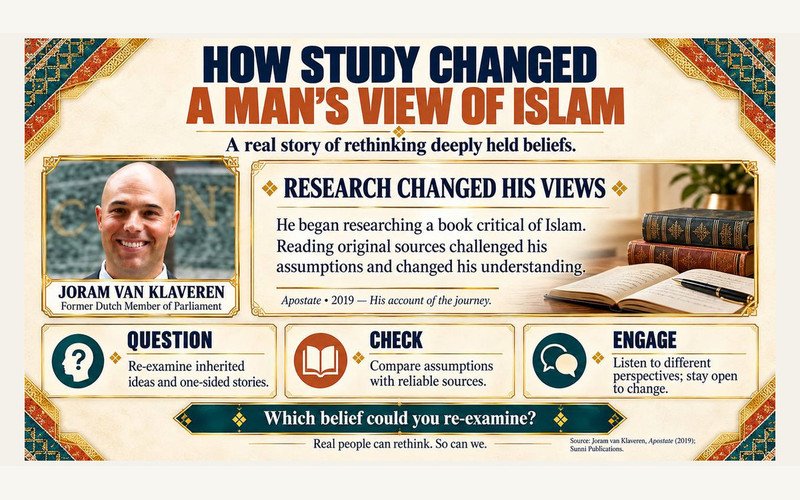
Joram van Klaveren, a former Dutch politician known for criticism of Islam, describes a substantial re-examination of his views in Apostate, published in English in 2019. [1] His account presents research and engagement with unfamiliar material as central to that process.
A memoir is evidence of how its author narrates an experience. It is not a controlled study of why people change their minds, and one person's journey cannot be prescribed as the outcome every reader should reach. The gallery's educational point is the willingness to investigate an inherited certainty, rather than an expectation that everyone adopt the author's conclusions.
A reported example from India
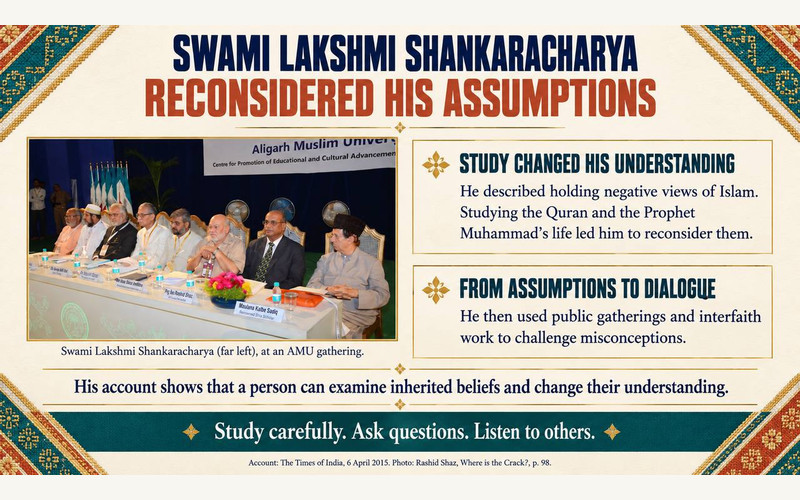
The Times of India reported in April 2015 that Swami Lakshmi Shankaracharya reconsidered earlier assumptions about Islam through study and dialogue. [5] This is a reported personal account, not an experimental result or evidence that he holds one of the four recognised Shankaracharya seats. Its relevance is the willingness to examine material before repeating an accusation.
Beliefs and automatic associations change differently
Implicit-bias research examines relatively automatic associations, which are not identical to a person's stated beliefs or conduct. A 2019 meta-analysis led by Patrick Forscher examined procedures intended to change implicit measures. It found that changing such measures did not reliably translate into corresponding changes in behaviour. [2]
That limitation is useful. Completing a short exercise or receiving a test score should not be treated as proof that prejudice has been removed. A person may need repeated practice, feedback and institutional rules that support fair decisions. The goal is not simply to feel unbiased but to act with better attention to evidence and consequences.
Listening can create a different kind of encounter
Broockman and Kalla's 2016 field experiment on perspective-taking conversations provides evidence that a carefully structured intervention can reduce a particular prejudice in a particular setting. [3] It does not establish a universal script for every disagreement.
The practical insight is modest: asking someone to reflect on experience can sometimes create space that a rapid exchange of accusations does not. Listening still permits disagreement. It means understanding the person's actual account before responding, rather than arguing with a stereotype of what they must think.
Build habits that expose mistakes
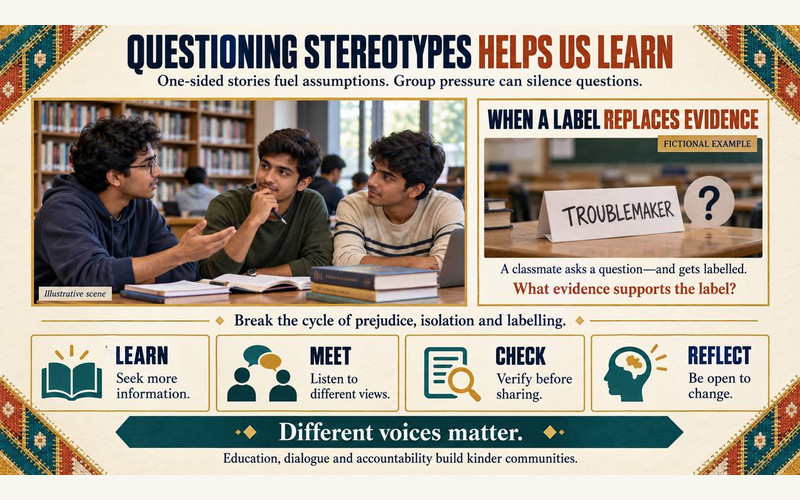
A classroom can make revision ordinary by asking pupils to explain what changed their understanding. A reading group can compare a quotation with its original context. A family discussion can separate “I heard this” from “this has been established.” These are illustrative practices, not a claim that each has been tested as a complete intervention.
Online, lateral reading offers a concrete information habit: leave an unfamiliar page to investigate who is behind it and what reliable sources say about it. Research comparing expert and novice evaluation helped articulate this approach. [4] Confidence in a page's appearance is a poor substitute for knowledge of its provenance.
Correction without humiliation
A clear correction identifies the mistake and supplies the better evidence. It need not add ridicule, speculate about someone's intelligence or demand a performance of shame. At the same time, civility should not become an excuse to leave harmful falsehoods uncorrected.
The gallery's invitation to an open mind is therefore active. Learn enough to recognise a gap, meet people without making them defend a whole population, check claims and reconsider the conclusion. A revised judgment is valuable when it becomes more accurate and fair, not merely when it becomes more comfortable.
Important Distinction
A personal transformation story can illuminate an experience. It cannot establish a general causal law. Open-mindedness also does not require treating every source as equally credible.
Sources & Further Reading
1. Joram van Klaveren. Apostate, English edition, 2019; publisher's text. https://kennishuys.com/wp-content/uploads/2019/01/Inside-Boek-Apostate-Joram-van-Klaveren.pdf
2. Patrick S. Forscher and colleagues. A Meta-Analysis of Procedures to Change Implicit Measures, Journal of Personality and Social Psychology, 2019. https://pubmed.ncbi.nlm.nih.gov/31192631/
3. David Broockman and Joshua Kalla. Durably reducing transphobia: A field experiment on door-to-door canvassing, Science, 2016. https://doi.org/10.1126/science.aad9713
4. Sam Wineburg and Sarah McGrew. Lateral Reading and the Nature of Expertise: Reading Less and Learning More When Evaluating Digital Information, Teachers College Record, 2019. https://doi.org/10.1177/016146811912101102
5. The Times of India. Swami who busts myths around Prophet Mohammad, 6 April 2015. https://timesofindia.indiatimes.com/city/agra/swami-who-busts-myths-around-prophet-mohammad/articleshow/46828356.cms
Related Topics
Implicit bias and the space between reaction and choice
Checking fabricated claims distorted facts and false context