
In Brief
An automatic association is a quick mental connection that may influence what we notice or how we interpret an event. It is not a reliable verdict on someone's character. The Implicit Association Test measures relative response speeds when people sort concepts; its developers warn against treating it as an individual diagnosis or selection tool. Stereotype threat is a different phenomenon: concern about being judged through a negative group stereotype. Both areas of research require qualifications. Fairer behaviour depends on checking assumptions and improving decisions and environments, rather than expecting one test or awareness session to remove bias.
Detailed Story
What an automatic association can do
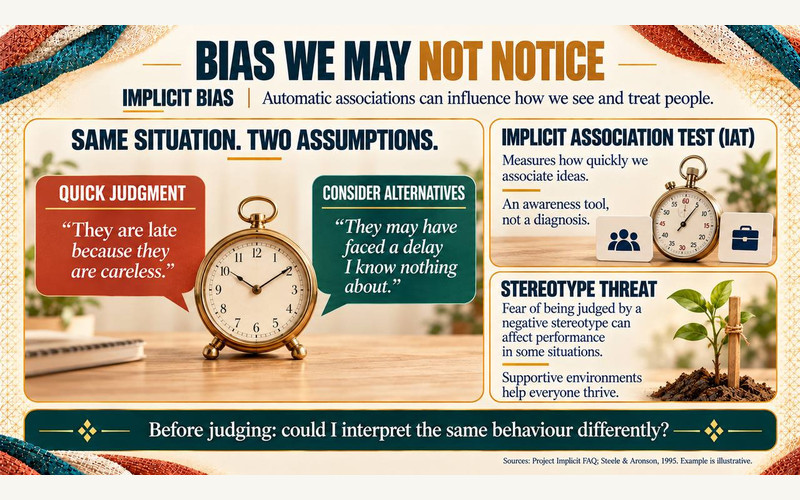
Imagine two colleagues missing the start of a meeting. One is familiar; the other belongs to a community about which a listener has heard negative stories. The same lateness may be interpreted as an unavoidable delay in the first case and a character flaw in the second. This illustrative example concerns attribution: the explanation attached to behaviour. It does not prove what any particular person was thinking.
Automatic reactions and deliberate commitments need not coincide. Someone can sincerely support equal treatment yet draw on learned associations when hurried or distracted. Conversely, a negative association recorded in a task does not demonstrate that the person will discriminate in a particular decision. The responsible question is how judgements and outcomes can be examined, rather than who can be labelled morally defective.
What the IAT measures
The Implicit Association Test, or IAT, compares how quickly people sort paired categories. A difference in response speed is interpreted as evidence about relative associations within that task. Project Implicit describes the public tests as tools for reflection and research, not instruments for diagnosing an individual's prejudice or deciding who should be hired. Scores can vary, and practice with a task can affect performance. [1]
This limitation does not mean that every study using an implicit measure is meaningless. It means that a research instrument has a particular scope. A temperature reading and a full medical diagnosis are different kinds of claim; likewise, performance on an association task and a conclusion about someone's future behaviour are different claims.
Awareness is not the same as lasting change
A 2019 meta-analysis by Patrick Forscher and colleagues examined 492 studies involving 87,418 participants. Procedures could change implicit measures, but changes in those measures did not reliably translate into corresponding changes in explicit attitudes or behaviour. [2] A short workshop may start a useful conversation without establishing that hiring, grading or service delivery has become fairer.
An organisation therefore needs observable checks. In recruitment, assess candidates against the same relevant criteria and record the reasons for decisions. In a classroom, review whose contributions are interrupted and whether comparable mistakes receive comparable feedback. These are applications of a fairness principle: evaluate the actual decision and its consequences, not only a participant's reported intentions.
Stereotype threat concerns the person being evaluated
Stereotype threat refers to concern that one's performance will confirm a negative belief about one's group. It is not the same as the evaluator holding an implicit association. Studies have examined how an evaluative setting, instructions and group stereotypes interact. A 2019 meta-analysis found that estimates depended on features of the testing context and identified evidence of publication bias. It would therefore be inaccurate to claim that stereotype threat always occurs or explains every performance difference. [3]
Supportive conditions remain valuable without overstating a contested effect. Clear criteria, useful feedback and respectful treatment reduce unnecessary ambiguity. They allow people to understand what the task requires and how improvement will be judged.
Create a pause that changes the decision
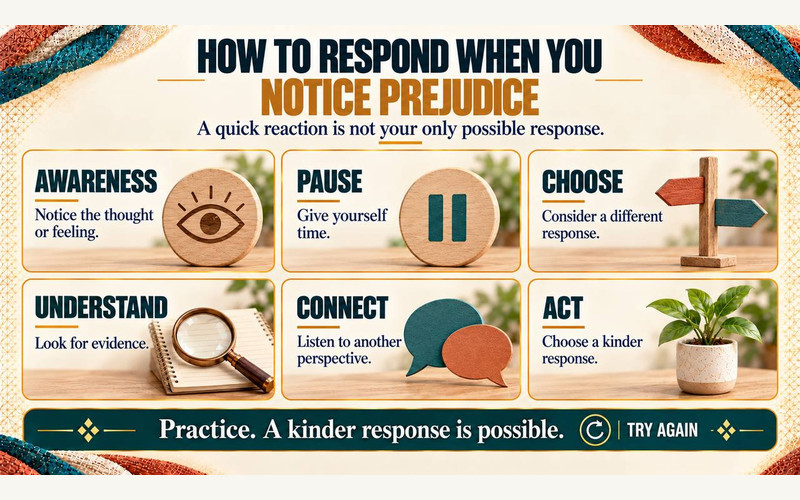
The gallery's sequence of noticing, pausing, choosing, understanding, connecting and acting is a practical reflection aid, not a validated six-stage clinical treatment. It can be used to identify a specific assumption: What did I observe? What explanation did I add? What alternative could I check? A pause becomes meaningful when it changes the next action, such as asking about the delay before assigning blame. Repetition and accountable procedures matter more than declaring oneself free of bias.
Facts & Figures
The 2019 Forscher review included 492 studies and 87,418 participants. [2]
Project Implicit advises against diagnostic or selection use of the IAT. [1]
The 2019 stereotype-threat review explicitly examined test-setting differences and publication bias. [3]
Important Distinction
Implicit association, conscious prejudice, discriminatory behaviour and stereotype threat are separate concepts. Evidence of one does not automatically establish the others.
Sources & Further Reading
1. Project Implicit. “About the IAT” and “Ethical Considerations,” undated. https://www.projectimplicit.net/resources/about-the-iat/ ; https://implicit.harvard.edu/implicit/ethics.html
2. Patrick S. Forscher et al. “A meta-analysis of procedures to change implicit measures.” Journal of Personality and Social Psychology, 2019. https://pubmed.ncbi.nlm.nih.gov/31192631/
3. Oren R. Shewach, Paul R. Sackett and Sander Quint. “Stereotype threat effects in settings with features likely versus unlikely in operational test settings: A meta-analysis.” Journal of Applied Psychology, 2019. https://pubmed.ncbi.nlm.nih.gov/31094540/
Related Topics
How prejudice develops and why group labels mislead