
In Brief
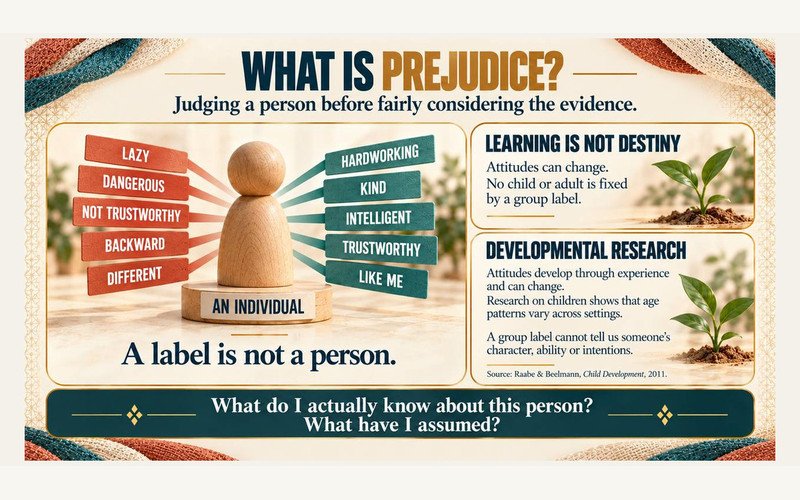
Prejudice is a judgement about people that gives their group identity more weight than fair consideration of their circumstances or conduct. Stereotypes are beliefs about groups; prejudice involves evaluation or feeling; discrimination concerns unequal treatment. These can reinforce one another, but they are not interchangeable. Group membership also provides friendship and belonging. The problem arises when belonging becomes a reason to deny others individuality or equal standing. Research on children and adults shows that attitudes are shaped by experience and social surroundings. They can change, although change is neither automatic nor identical for everyone.
Detailed Story
Categories help us think but can hide the person
People use categories to navigate a complicated social world. Language, occupation, religion and neighbourhood can help us understand someone's circumstances. Yet a category supplies only partial information. Knowing that a person is Muslim, Hindu, Sikh or Christian does not tell us whether that person is reliable, generous, skilled or dishonest. Those judgements require evidence about the individual.
A stereotype need not sound hostile to restrict someone. Assuming that every member of a community is naturally good at business can obscure differences in opportunity and discourage individuals from choosing other work. A favourable generalisation can become an expectation against which real people are unfairly measured. Equally, noticing a documented group-level disadvantage is not inherently prejudiced. The question is whether the information is used accurately to understand conditions or carelessly to decide an individual's worth.
How children learn social boundaries
In a 2011 meta-analysis, Tobias Raabe and Andreas Beelmann examined 113 research reports on ethnic, racial and national prejudice among children and adolescents. Across the combined evidence, prejudice tended to peak at ages five to seven and decrease slightly at ages eight to ten. Results differed with group status, social context and the way prejudice was measured. There was no single developmental trend throughout adolescence. These are average research patterns, not a timetable for diagnosing a child. [1]
Children also learn which distinctions adults consider important. A joke that consistently makes one community the target, a rule about whom to invite home, or an adult's unequal response to the same mistake can communicate a hierarchy without an explicit lesson. A constructive response explains the unfair judgement and supplies opportunities to encounter people as individuals. It does not label a child permanently prejudiced.
Belonging and separation can coexist
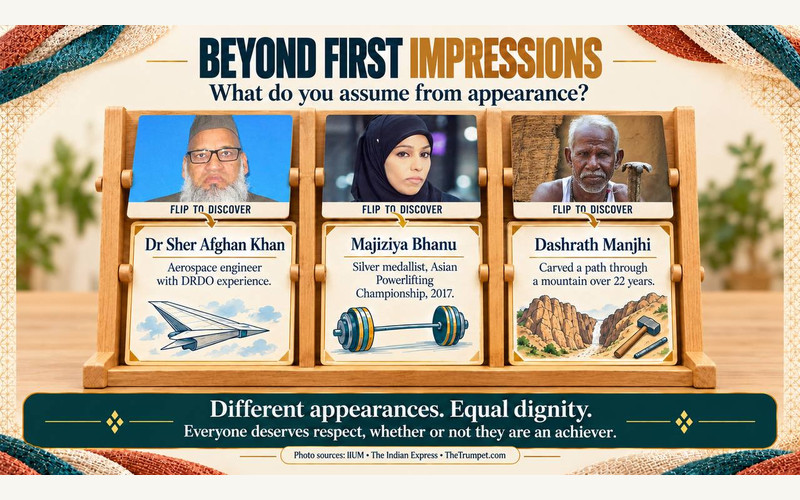
Pew Research Center's 2019–20 survey of Indian adults found that 85% said all or most of their close friends shared their religion. The research involved 29,999 adults and was published in 2021. This describes reported friendship networks at that time. It does not show that 85% disliked other religions, nor does it establish why their networks took that form. Residential patterns, family connections, schools, language and personal preference can all affect whom people meet. [2]
The distinction matters in Hyderabad. Speaking mostly to neighbours who share one's language can be understandable, while still leaving few opportunities to test assumptions about people outside that circle. A shared reading group or sports activity can widen experience without requiring anyone to abandon existing friendships. This is a practical application of the evidence, not a claim that every Hyderabad neighbourhood follows the same pattern.
Apply the same standard
A useful fairness test is to compare explanations. When a friend arrives late, do we imagine traffic, illness or a difficult morning, while describing an unfamiliar person as careless? When one member of our own group behaves badly, do we treat it as an individual failure, but turn another person's misconduct into a judgement about millions?
Changing this habit requires both attention and opportunity. Research reviewing intergroup contact generally finds lower prejudice where people have constructive contact across group boundaries. The benefit varies with circumstances; a hostile or unequal encounter can reinforce suspicion. [3] Fair judgement begins with asking what is actually known about the person, what remains uncertain and whether the same evidence would produce the same conclusion if the group label changed.
Facts & Figures
Raabe and Beelmann's 2011 review covered 113 research reports; its age patterns were averages, not universal stages. [1]
Pew's India survey interviewed 29,999 adults in 2019–20; 85% reported that all or most close friends shared their religion. [2]

Pettigrew and Tropp's 2006 review combined 515 studies of intergroup contact. [3]
Important Distinction
A stereotype is a generalised belief, prejudice an evaluative attitude, and discrimination an action or institutional practice. Someone can oppose prejudice sincerely while participating in an unfair practice; someone can hold a stereotype without acting on it in every situation.
Sources & Further Reading
1. Tobias Raabe and Andreas Beelmann. “Development of Ethnic, Racial, and National Prejudice in Childhood and Adolescence.” Child Development, 2011. https://doi.org/10.1111/j.1467-8624.2011.01668.x
2. Pew Research Center. “Religious segregation,” Religion in India, 2021; fieldwork 2019–20. https://www.pewresearch.org/religion/2021/06/29/religious-segregation/
3. Thomas F. Pettigrew and Linda R. Tropp. “A meta-analytic test of intergroup contact theory.” Journal of Personality and Social Psychology, 2006. https://doi.org/10.1037/0022-3514.90.5.751
Related Topics
Implicit bias and the space between reaction and choice