
In Brief
Hope becomes practical through actions that reduce harm and make cooperation possible. The gallery offers five: pause, verify, connect, speak respectfully and volunteer. These are habits, not a promise that individual goodwill can replace effective institutions. Kerala's flood response, assistance after violence and the Islamic teaching about planting even at the end of time illustrate different forms of responsibility. The common concern is what can still be done for another person. Good intentions become useful when they are joined to accurate information, consent and an understanding of actual needs.
Detailed Story
Pause before participating in harm
A pause interrupts the movement from emotion to action. When a message produces immediate fear or anger, identify what it asks you to do: forward an accusation, identify a neighbour, boycott a business or join a crowd. The urgency of the instruction is not evidence that its claim is true.
Pausing does not mean ignoring an immediate threat. It means distinguishing the need to obtain help from the impulse to amplify unverified material. An affected person's safety can require prompt action while the wider story is still uncertain.
Verify the claim that matters
Find the original source, date and location. Separate a genuine photograph from the caption attached to it. Look for a report that supplies evidence rather than several accounts repeating one another. The Council of Europe's information-disorder framework distinguishes false information, intentional deception and harmful uses of genuine information. [1]
Verification also applies to appeals for assistance. Confirm the organisation, the request and the intended use of resources. A well-meaning but inaccurate appeal can divert attention or supplies from people who need them.
Connect before a crisis
An ordinary relationship creates possibilities that an emergency introduction may not. Knowing a neighbour's name, participating in a shared activity or maintaining contact across a workplace can make it easier to ask a direct question when a rumour appears.
The revised gallery includes specific examples of shelter during floods, assistance with funerals and cooperation around health needs. Articles 28–32 describe these dated events and their sources. Their relevance here is that mutual assistance can cross the boundaries a hostile narrative tries to harden.
Speak with precision and respect
A response to a prejudiced claim can identify the specific problem: the evidence is missing, the image is old or an individual's conduct is being assigned to a community. Respectful speech need not weaken that correction. It keeps the focus on what can be established and on the people who may be harmed.
Public courage also includes supporting someone after an incident. Citizens for Justice and Peace describes its work with survivors of Gujarat's 2002 violence through legal assistance, documentation and advocacy. [2] Its organisational account establishes its aims and activities; particular legal outcomes must be checked against the relevant judgments.
Volunteer in response to real needs
Kerala's 2018 floods brought local knowledge and community participation into rescue and recovery, including the contribution of fishermen. The post-disaster needs assessment prepared with government and international partners documents the scale and complexity of the disaster response. [3] Such examples show why specialised local skills can matter alongside formal institutions.
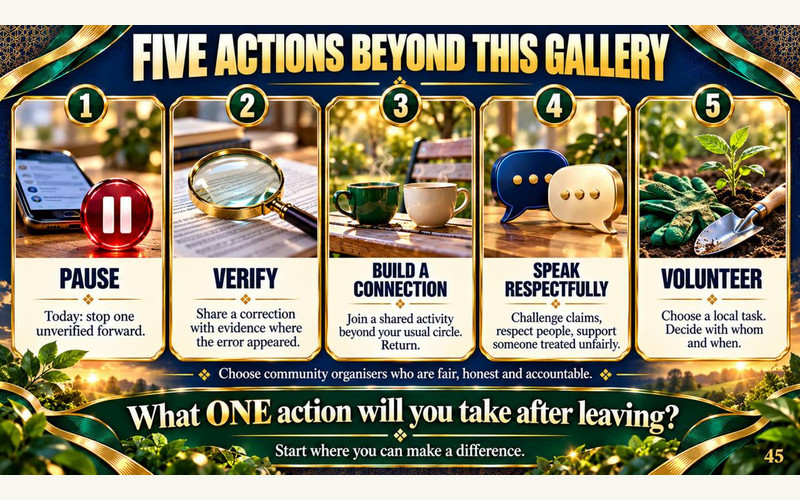
Volunteering works best when it fits a real role: sorting supplies requested by an established relief effort, offering an appropriate professional skill or helping with a sustained neighbourhood activity. Uncoordinated assistance can create extra work. Blood donation, another gallery example, should likewise take place through an authorised service that assesses donor eligibility and actual demand.
Planting as an ethical image
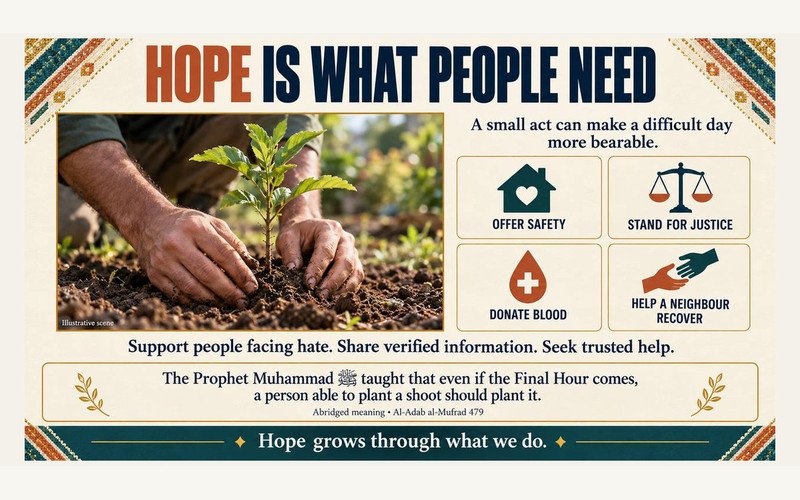
A report attributed to the Prophet Muhammad in al-Bukhari's Al-Adab al-Mufrad, reference 479, describes planting a shoot even if the Final Hour arrives, where doing so remains possible. [4] The idea is paraphrased here: constructive responsibility does not become meaningless simply because the future is uncertain. This collection is distinct from Sahih al-Bukhari; references should not conflate the two.
The teaching is a religious encouragement, not an empirical prediction. Placed beside civic examples, it invites a practical question: what useful act remains within reach? Hope gains substance when the answer becomes a responsible action and, where possible, a continuing commitment.
Facts & Figures
The Kerala flood example concerns the 2018 disaster and its subsequent needs assessment. [3]
Citizens for Justice and Peace was formed in 2002. [2]
The planting report is Al-Adab al-Mufrad 479, not a hadith number in Sahih al-Bukhari. [4]
Important Distinction
Individual service complements public responsibility; it does not remove the need for accountable institutions, equal protection and reliable services.
Sources & Further Reading
1. Claire Wardle and Hossein Derakhshan. Information Disorder: Toward an Interdisciplinary Framework for Research and Policy Making, Council of Europe, 2017. https://edoc.coe.int/en/media/7495-information-disorder-toward-an-interdisciplinary-framework-for-research-and-policy-making.html
2. Citizens for Justice and Peace. CJP's Impact, organisational account of work since 2002. https://cjp.org.in/cjps-impact/
3. Government of Kerala, United Nations, World Bank and European Union. Kerala Post Disaster Needs Assessment: Floods and Landslides, 2018; UNDP publication page. https://www.undp.org/publications/post-disaster-needs-assessment-kerala
4. Muhammad ibn Isma'il al-Bukhari. Al-Adab al-Mufrad, report 479, narrated by Anas ibn Malik; Book 27, report 4 in the online arrangement. https://sunnah.com/adab/27
Related Topics
Checking fabricated claims distorted facts and false context