
Related slides 55
The economic activity around a festival
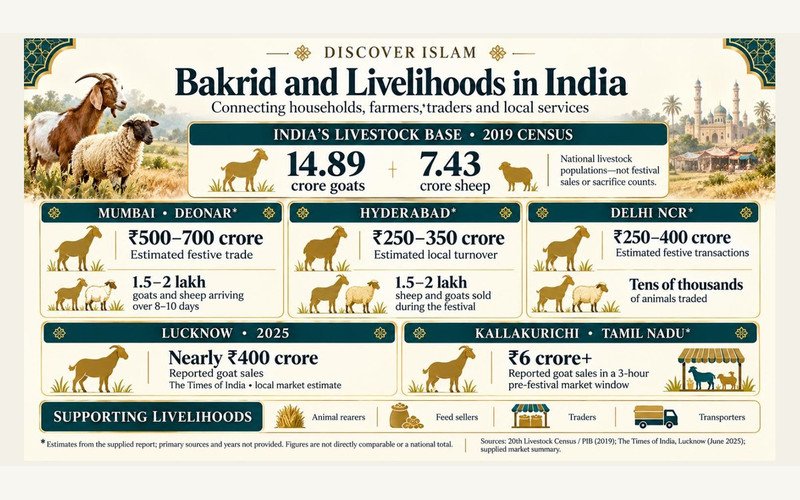
Demand around Bakrid connects livestock rearers, traders, transport workers, fodder sellers and other services. This is a practical economic relationship alongside the festival's religious meaning. The people involved can come from different communities, but a percentage or community breakdown should not be asserted without data.
Livestock totals are not festival totals
The government's 2019 livestock census release recorded about 14.89 crore goats and 7.43 crore sheep in India. These numbers describe the national livestock population at that time. They are not the number sold or sacrificed at Bakrid, and they are not a current festival market estimate.
Livestock supports livelihoods throughout the year through several uses and markets. A large national animal population therefore cannot be treated as an economic benefit caused solely by one festival.
What local reports show
A Times of India report in June 2025 described Lucknow's Bakrid goat trade as approximately Rs 400 crore, drawing on local market accounts. This is a reported estimate, not an official national survey. Its component market figures are not fully consistent, so it should not be used as a precise audited amount. Reports from Hyderabad describe seasonal markets attracting traders from neighbouring states. A May 2026 report describes more than Rs 6 crore in sales over three hours at Ulundurpet in Kallakurichi district. These examples refer to different years and areas.
What cannot be concluded
Sales turnover is not the same as profit, household income or net contribution to the economy. It includes costs and may include resales along a supply chain. Adding estimates for overlapping markets could double-count the same trade.
The defensible conclusion is modest but meaningful: seasonal demand can support a range of livelihoods. That observation does not settle questions about animal welfare or justify inflated totals. Fair prices, safe transport, responsible handling and reliable evidence are part of a credible account of the festival's economic role.
Sources: Livestock census [38]; Lucknow market [39]; Hyderabad market [40]; Kallakurichi market [41]
Read next: Shariah and the interpretation of guidance