
Related slides 46, 49
Work and enterprise have a place
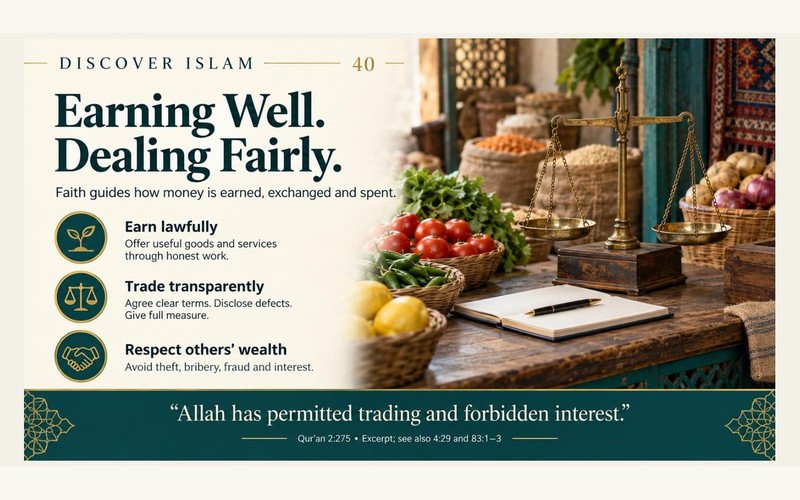
Islam permits earning through useful work, trade and investment that meet its ethical requirements. It does not require everyone to possess the same amount of wealth. It does ask how money was acquired, what obligations accompany it and whether other people's rights were respected.
Fair terms and honest exchange
The Qur'an condemns taking people's wealth wrongfully and giving short measure. For a trader, the principle includes accurate weights, clear prices and disclosure of relevant defects. In a service business, it can mean describing what will be delivered and charging according to the agreement. Bribery and deception undermine the fairness of the exchange.
Consent matters, but calling a transaction voluntary does not automatically make every term ethical. Islamic law also considers the nature of the product and prohibitions such as interest, gambling and serious contractual uncertainty.
Different ways wealth reaches people
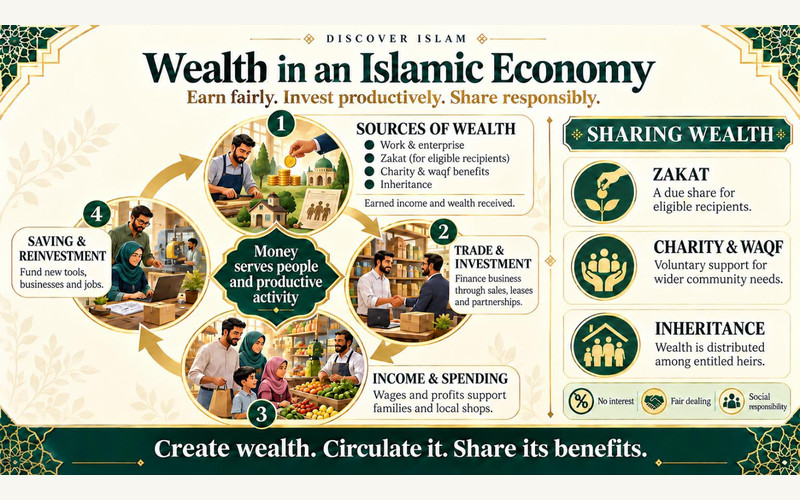
The display includes work, business, inheritance and assistance. These need to be distinguished. Work and enterprise generate income; inheritance transfers a deceased person's property; zakat and voluntary charity transfer support to recipients. Receiving aid is not the same economic activity as producing goods, although all can become sources of resources for a household.
Waqf means an endowment dedicated to an allowed purpose, often with an asset or its income supporting education, worship or public benefit. It has its own rules and is not simply another word for zakat. Inheritance similarly follows detailed rules rather than an unrestricted decision to share in any proportion.
An ideal and its implementation
Saving and reinvesting can support productive work. Giving can meet needs that markets do not meet fairly. These are potential functions, not proof that any system bearing an Islamic label will automatically remove poverty or inequality. Real outcomes depend on institutions, administration and people's conduct. The moral aim is to connect earning with fairness and ownership with responsibility.
Qur’anic verses
Qur'an 4 : 29
You who believe, do not consume one another's wealth wrongfully. Let there be trade by mutual agreement. Do not kill yourselves or one another. God is merciful towards you.
Read the verse and Arabic text
Qur'an 83 : 1
Woe to those who give short measure,
Read the verse and Arabic text
Qur'an 83 : 2
who demand full measure when receiving from other people,
Read the verse and Arabic text
Qur'an 83 : 3
but give less when they measure or weigh for others.
Read the verse and Arabic text
Qur'an 2 : 188
Do not consume one another's wealth wrongfully, or use it to influence judges so that you knowingly consume a portion of other people's wealth unjustly.
Read the verse and Arabic text
Read next: Why Islam prohibits interest on loans