
Related slides 54
What Bakrid commemorates
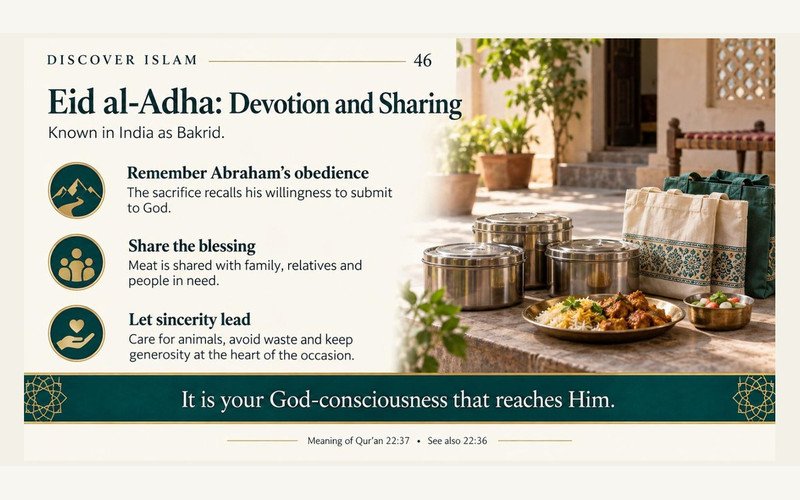
Eid al-Adha, commonly called Bakrid in India, is a Muslim festival associated with Abraham's willingness to obey God. In the Qur'anic account, Abraham and his son submit to the test, and the son is ransomed with a great sacrifice. The passage does not name the son; the prevalent Muslim identification is Ishmael. The story highlights trust in God and willingness to put duty before personal attachment.
The place of animal sacrifice
Muslims who undertake the sacrifice offer an eligible animal according to religious rules and share its meat. The act expresses devotion and gratitude and can provide food for relatives and people in need. The practice has conditions concerning a person’s means and the animal offered. It should not be presented as compulsory for every Muslim regardless of circumstances.
The Qur'an explicitly states that neither the meat nor the blood reaches God; what matters is God-consciousness. This rules out the idea that God needs to be fed. The outward act is meant to express an inward commitment.
Sharing requires consideration
Caring for the animal, arranging lawful slaughter, maintaining hygiene and disposing of waste responsibly are part of responsible practice. Sharing food should respect the recipient's preferences. A vegetarian neighbour should not be pressured to accept meat as a test of friendship.
The event can be explained positively without pretending that everyone agrees with animal sacrifice. For Muslims, it has a specific religious meaning. For other visitors, understanding that meaning can coexist with ethical disagreement. The quality of the observance is not measured by the price of the animal or public display, but by sincerity and responsible conduct.
Qur’anic verses
Qur'an 37 : 102
When the boy was old enough to work alongside him, Abraham said: My son, I have seen in a dream that I sacrifice you. Consider what you think. He replied: My father, do what you are commanded. God willing, you will find me among the patient.
Read the verse and Arabic text
Qur'an 37 : 103
When they had both submitted, and Abraham had laid him down on his forehead,
Read the verse and Arabic text
Qur'an 37 : 104
We called to him: Abraham!
Read the verse and Arabic text
Qur'an 37 : 105
You have fulfilled the vision. This is how We reward those who do good.
Read the verse and Arabic text
Qur'an 37 : 106
This was certainly a clear test.
Read the verse and Arabic text
Qur'an 37 : 107
We ransomed him with a great sacrifice.
Read the verse and Arabic text
Qur'an 22 : 36
We have made the sacrificial camels among God's sacred symbols for you. There is good in them for you. Mention God's name over them as they stand in rows. When they have fallen on their sides, eat from them and feed both those who do not ask and those who ask. We have placed them at your service so that you may be thankful.
Context: The Arabic term is also rendered “sacrificial animals” or “cattle”. This verse’s scene does not by itself list every permitted species or all slaughter rules.
Read the verse and Arabic text
Qur'an 22 : 37
Their meat and blood do not reach God. What reaches Him is your mindfulness of Him. He has placed them at your service so that you may honour His greatness for guiding you. Give good news to those who do good.
Read the verse and Arabic text
Sources: Sacrifice ruling [47]
Read next: Bakrid and livelihoods in India