
Related slides 36–38
What the pilgrimage is
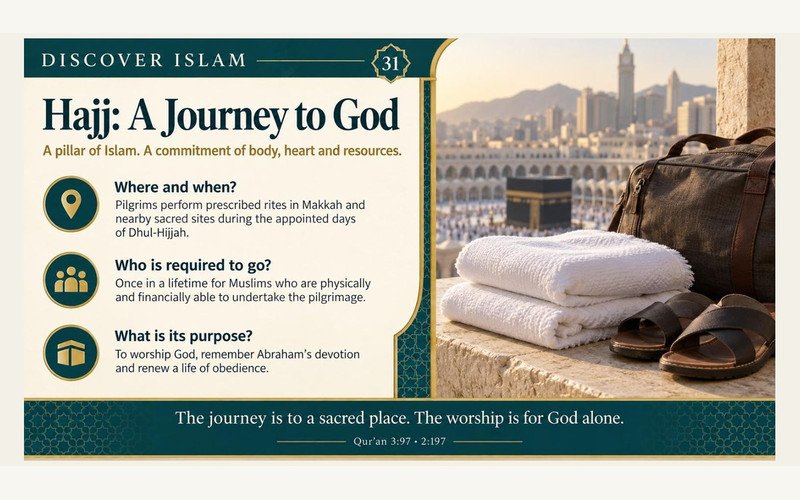
Hajj is the pilgrimage to Makkah and nearby sacred sites during appointed days of the lunar month of Dhul-Hijjah. It involves prescribed rites and is required once in a lifetime for Muslims who meet its conditions of ability. Financial means and physical capacity matter. It is different from umrah, a shorter pilgrimage that can be performed at other times.
Why people travel
The journey expresses worship of God and recalls the devotion of Abraham and his family within Islamic tradition. Pilgrims move through rites that include standing at Arafat and walking around the Ka'bah. Walking around the building does not mean worshipping its stones. As in daily prayer, the worship is directed to God.
Hajj also requires patience in a large gathering. The Qur'an warns against misconduct and quarrelling during it. Its religious meaning therefore includes how pilgrims treat one another, not merely completing movements at the correct places.
What the simple clothing means
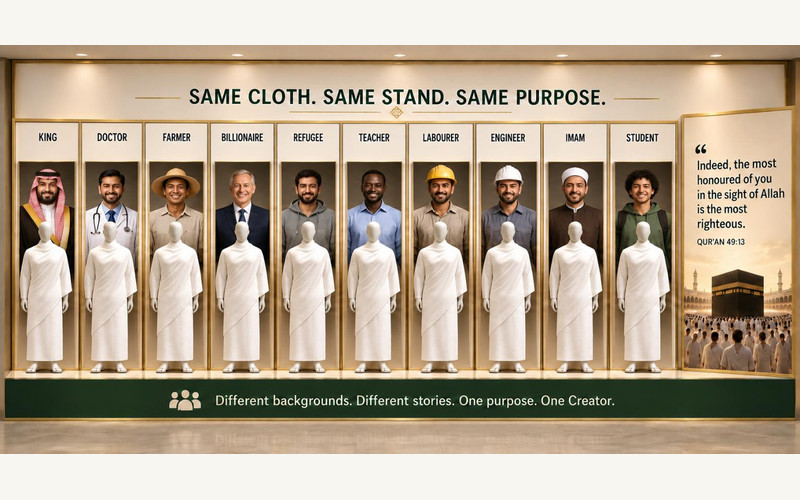
Men ordinarily enter the sacred state called ihram wearing two simple cloths. Women observe clothing requirements but do not wear the same two-cloth outfit. The model's identical white outfits illustrate the men's practice, not a universal uniform for every pilgrim.
The display contrasts different occupations and social positions to show that wealth and job titles do not determine a person's worth before God. That is a moral ideal. It does not mean that every pilgrim can afford the same travel package or that all social inequalities disappear at Hajj.
A lesson carried home
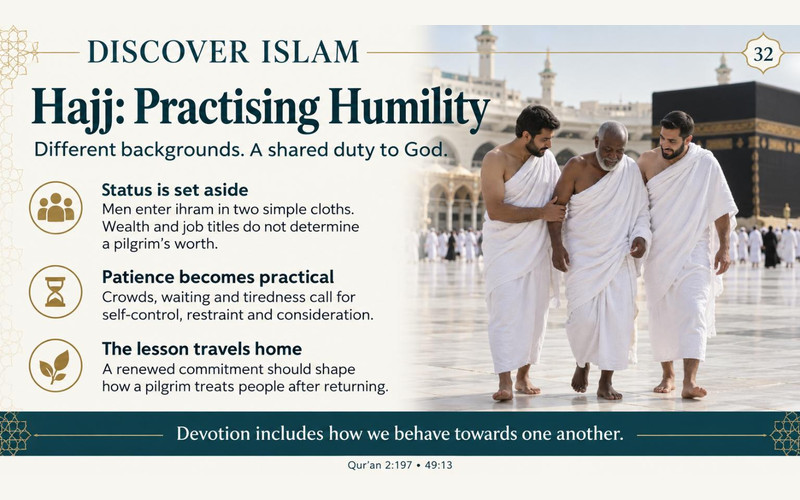
The Qur'an connects human diversity with knowing one another and places moral worth above inherited status. A pilgrimage that encourages humility should influence life afterwards: how someone speaks to a worker, handles frustration or treats a stranger. A visitor does not need to undertake the journey to understand its intended lesson. The sacred gathering gives a visible form to shared devotion and responsibility.
Qur’anic verses
Qur'an 3 : 97
In it are clear signs, including the place where Abraham PBUH stood. Whoever enters it is safe. Pilgrimage to the House is a duty owed to God by those who can make the journey. As for those who reject it, God has no need of any of His creation.
Context: The passage concerns the sanctuary at Makkah. Its sacred status is not a claim that no crime or tragedy has ever happened there.
Read the verse and Arabic text
Qur'an 2 : 197
The pilgrimage takes place in well-known months. Whoever undertakes it must avoid sexual relations, wrongdoing and quarrelling during the pilgrimage. Whatever good you do, God knows it. Take provisions, but the best provision is mindfulness of God. So be mindful of Me, people of understanding.
Read the verse and Arabic text
Qur'an 49 : 13
People, We created you from a male and a female and made you into peoples and tribes so that you may know one another. The most honoured of you before God is the one most mindful of Him. God knows everything and is fully aware.
Context: Moral standing before God cannot be reliably measured from someone’s wealth, name, clothing or community label.
Read the verse and Arabic text
Hadith
Saying of Prophet Muhammad (PBUH) — Sahih al-Bukhari 8
Plain-English meaning
Islam rests on five foundations: declaring that only God deserves worship and Muhammad is His messenger; maintaining prayer; giving zakat; performing Hajj; and fasting in Ramadan.
Sources: Prophet Muhammad (PBUH) — Sahih al-Bukhari 8 [5]; Hajj guide [46]
Read next: Faith and the rights of other people