
Related slides 28–31
What the fast involves
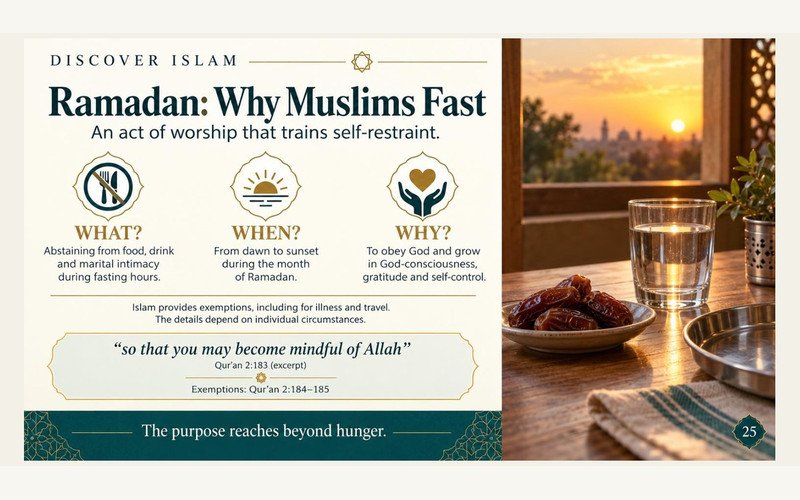
Ramadan is a month in the Islamic lunar calendar. During its daily fast, Muslims who are required and able to fast abstain from food, drink and sexual relations from dawn until sunset. Food and drink are permitted at night. The fast begins at dawn, not sunrise. Because the lunar year is shorter than the solar year, Ramadan moves through the seasons over time.
A purpose beyond hunger
The Qur'an connects fasting with God-consciousness: awareness of God in one's choices. A person may be able to eat unseen, but the religious commitment remains. Restraining an ordinary appetite can become practice in restraining anger, dishonesty or a harmful impulse.
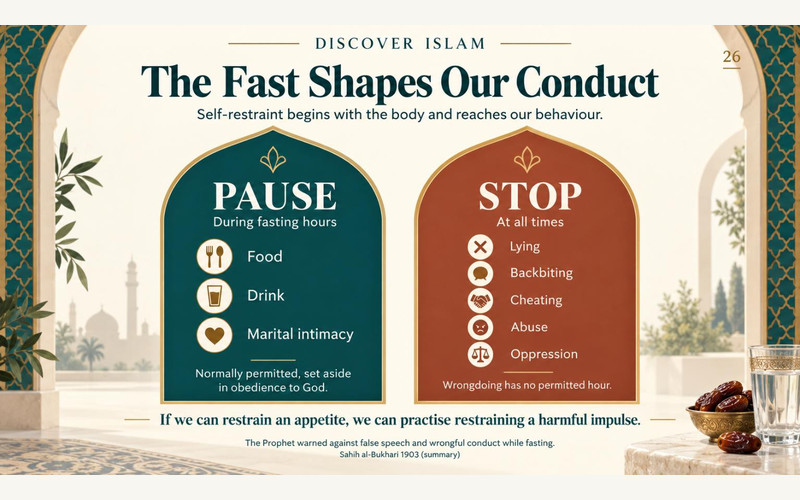
This does not mean that fasting automatically creates good character. Prophet Muhammad (PBUH) — Sahih al-Bukhari 1903 — warns against false speech and wrongful conduct during a fast. Lying, cheating and abuse remain wrong outside Ramadan too. The temporary restriction on food should not obscure these continuing duties.
Who may be exempt
The Qur'an explicitly provides allowances for illness and travel. Other circumstances, including menstruation and some conditions involving pregnancy, breastfeeding, old age or lasting inability, are addressed in Islamic law. Depending on the situation, duties may include making up days or feeding people in need. The allowance for feeding people in need in Qur'an 2 : 184 should be read alongside Qur'an 2 : 185; it is not a general replacement for fasting for every healthy adult. The gallery is explaining a practice, not giving personal medical or religious advice.
Care beyond sunset
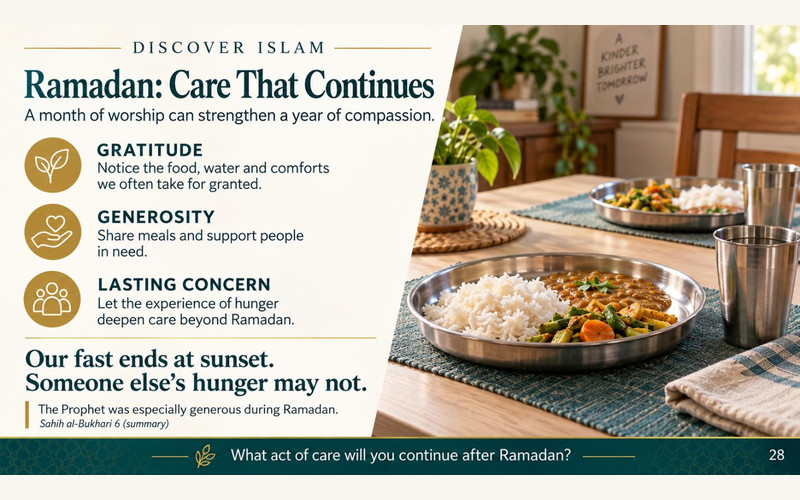
The experience can encourage gratitude for reliable food and water and awareness of others' needs. A report about Prophet Muhammad (PBUH) — Sahih al-Bukhari 6 — describes his exceptional generosity in Ramadan. Shared meals and giving often accompany the month.
A short voluntary experience of hunger does not reproduce the full insecurity of poverty. Its value depends partly on whether awareness leads to continued help. Fasting is first an act of worship; claims that it guarantees weight loss, cures illness or produces a particular scientific benefit are unnecessary to explain its religious meaning.
Qur’anic verses
Qur'an 2 : 183
You who believe, fasting has been prescribed for you, as it was prescribed for those before you, so that you may become mindful of God.
Read the verse and Arabic text
Qur'an 2 : 184
Fast for a set number of days. Anyone among you who is ill or travelling should fast an equal number of other days. For those who can fast only with hardship, compensation is feeding a person in need. Whoever freely does more good, it is better for them. And fasting is better for you, if only you knew.
Read the verse and Arabic text

Qur'an 2 : 185
Ramadan is the month in which the Qur'an was revealed as guidance for humanity, with clear proofs of guidance and a standard for distinguishing right from wrong. Whoever among you is present during the month should fast it. Anyone who is ill or travelling should fast an equal number of other days. God wants ease for you, not hardship, so that you may complete the required period, honour God's greatness for guiding you, and be thankful.
Read the verse and Arabic text
Qur'an 2 : 187
Sexual relations with your wives are permitted to you on the nights of the fast. They are clothing for you, and you are clothing for them. God knew that you were betraying yourselves, so He turned to you in mercy and pardoned you. Now you may have relations with them and seek what God has appointed for you. Eat and drink until the white thread of dawn becomes distinct from the black thread of night. Then complete the fast until nightfall. Do not have sexual relations with them while you are staying in the mosques for devoted worship. These are God's limits, so do not approach them. In this way God makes His signs clear to people so that they may become mindful of Him.
Context: “Clothing” is an image of intimacy and mutual closeness. Staying for devoted worship means a religious retreat in the mosque. Dawn, rather than sunrise, begins the daily fast.
Read the verse and Arabic text
Hadith
Saying of Prophet Muhammad (PBUH) — Sahih al-Bukhari 1903
Plain-English meaning
If a person keeps lying and acting wrongly, God has no need of that person going without food and drink.
Saying of Prophet Muhammad (PBUH) — Sahih al-Bukhari 6
Narrated description — plain-English meaning
Ibn Abbas (RA) described Prophet Muhammad (PBUH) as exceptionally generous, especially during Ramadan. Gabriel met him each night to review the Qur’an, and his readiness to give was compared to a freely blowing wind.
Sources: Prophet Muhammad (PBUH) — Sahih al-Bukhari 1903 [15]; Prophet Muhammad (PBUH) — Sahih al-Bukhari 6 [16]
Read next: Zakat and responsibility for wealth