
In Brief
Assistance can respect a family's beliefs without requiring helpers to share them. The gallery's examples include funeral support during the pandemic, neighbours finding burial space, a temple hall hosting Eid prayers and help with travel to carry out a family rite. These accounts concern practical obstacles at vulnerable moments. They also require careful distinctions: fear of COVID was not proof of the cause of death, and helping with arrangements was not necessarily the same as performing every ritual. Dignity includes listening to what the affected family actually needs.
Detailed Story
Fear and funeral arrangements
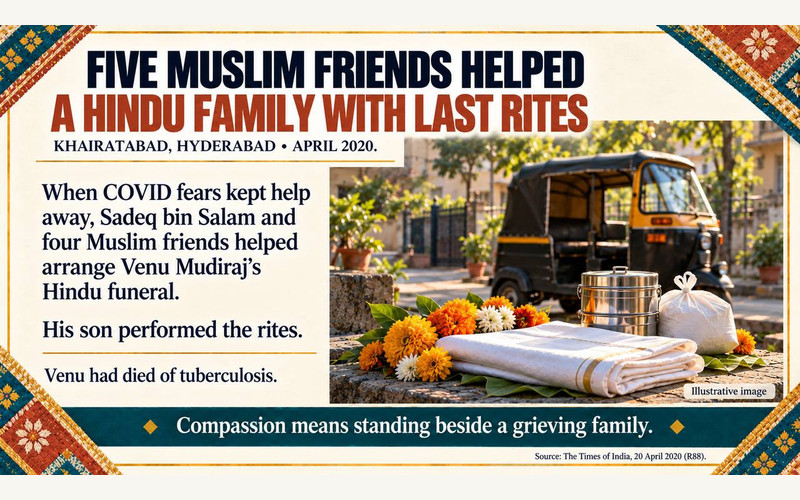
In April 2020, five Muslim friends helped Venu Mudiraj's Hindu family with last rites in Khairatabad, Hyderabad. The report identified tuberculosis as the cause of death, while neighbours feared COVID. His son performed the rites. [5] Preserving those details prevents the story from repeating the very confusion that complicated the family's situation.
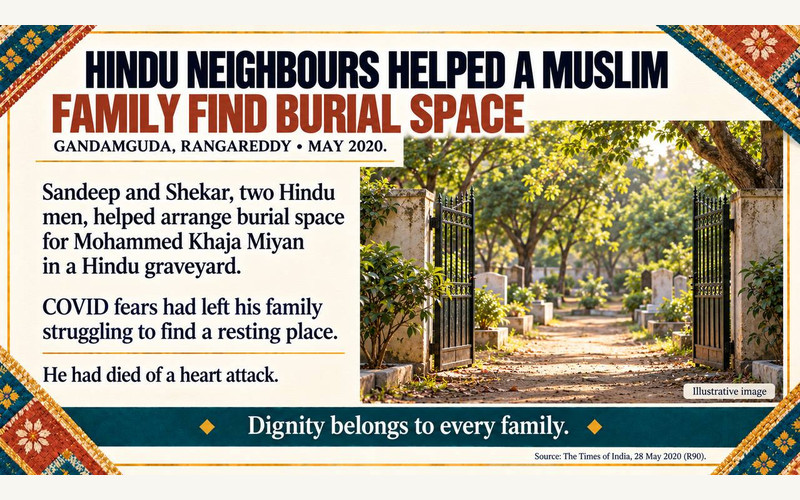
In May 2020, Sandeep and Shekar helped Mohammed Khaja Miyan's family obtain burial space in a Hindu graveyard after difficulty finding a place amid COVID fears. The reported death followed cardiac arrest; it was not described as a confirmed COVID death. [6] The death date and publication date also differ: 22 May and 28 May respectively.
Organised help across communities
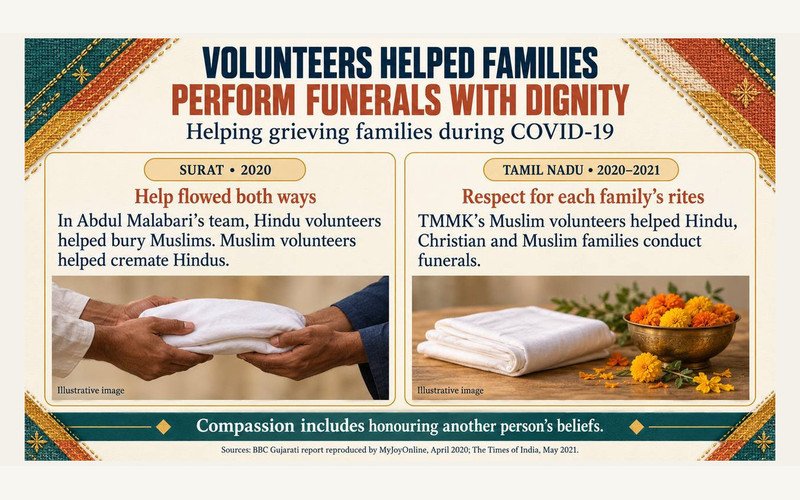
A BBC account reproduced by MyJoyOnline described Abdul Malabari's team in Surat assisting with funerals across faiths during the pandemic. [1] Reporting from Tamil Nadu described TMMK volunteers responding to families' wishes concerning funeral arrangements. [2] These are separate examples, and the republication of a BBC story should not be counted as an independent second investigation of the same events.
Such assistance can involve transport, coordination and practical support. It should not automatically be described as a helper personally performing every religious rite. The distinction preserves the family's role and avoids implying that volunteers speak for every tradition. The reporting supports particular arrangements, not a single rule governing all Hindu, Muslim or Christian funerals.
Respect extends beyond the immediate funeral
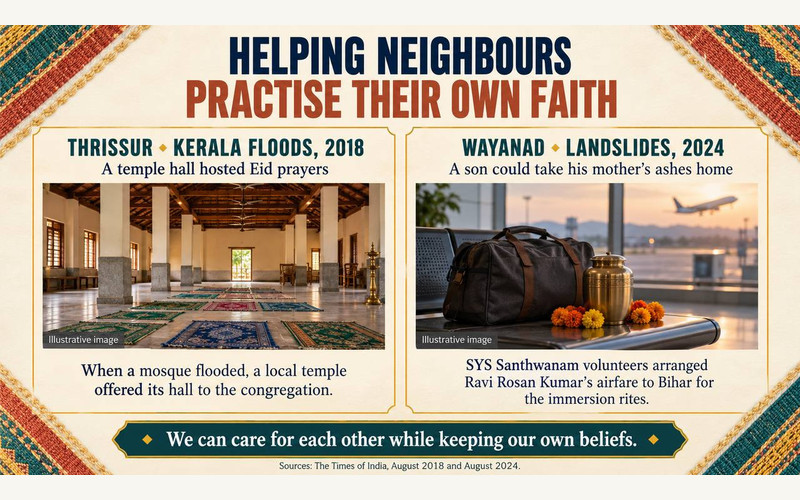
After Kerala's floods in August 2018, a hall attached to a temple at Eravathur near Mala hosted Eid prayers for members of a flooded mosque. [3] The report concerns the temple hall; it does not establish that prayers took place in the sanctum. Keeping the location precise strengthens, rather than diminishes, the example of accommodation.
Following the Wayanad landslides in 2024, SYS Santhwanam arranged airfare for Ravi Rosan Kumar to take his mother's ashes to Bihar. [4] The practical help concerned travel for a family rite. It should not be embellished with an invented ceremony, destination within Bihar or account of what every participant believed.
Assistance without taking over
These accounts raise a simple question: who gets to define what respectful help looks like? A family facing grief may need support while retaining authority over personal decisions. Listening to its request can be more useful than assuming that one familiar practice applies to everyone. This is an ethical interpretation of the examples, not a claim that the reports provide a complete account of every conversation.
Respect does not require a volunteer to endorse every religious explanation. It requires recognising that another person's convictions and attachments matter to that person. Making space for a rite, arranging travel or helping overcome an obstacle can express that recognition in a concrete way. The act becomes intelligible without turning it into a contest over whose beliefs are correct.
The gallery also asks readers to distinguish verified information from fear. An unsupported assumption about illness can create new barriers for a grieving family. Responsible communication identifies what is known and avoids attaching blame to a religion or household. A dignified response combines accurate information with attention to the people who are trying to make arrangements at a difficult time.
Important Distinction
COVID-related fear is not a diagnosis. Supporting a family's arrangements is not necessarily performing its rites, and accommodation does not require shared belief.
Sources & Further Reading
1. The man giving dignified burial to Covid-19 victims - MyJoyOnline. https://www.myjoyonline.com/the-man-giving-dignified-burial-to-covid-19-victims/
2. Cutting across faith, TMMK volunteers give dignified burial | Chennai News - Times of India. https://timesofindia.indiatimes.com/city/chennai/cutting-across-faith-tmmk-volunteers-give-dignified-burial/articleshow/82992456.cms
3. Kerala Floods: Kerala: Temple hall hosts Eid prayers for members of flooded mosque | Kochi News - Times of India. https://timesofindia.indiatimes.com/city/kochi/kerala-temple-hall-hosts-eid-prayers-for-members-of-flooded-mosque/articleshow/65504854.cms
4. Wayanad disaster: Muslim organization comes to Hindu family’s aid | Kochi News - Times of India. https://timesofindia.indiatimes.com/city/kochi/wayanad-landslides-muslim-organization-comes-to-hindu-familys-aid/articleshow/112253999.cms
5. Hyderabad: Five Muslim men organise last rites of Hindu man shunned by neighbours | Hyderabad News - Times of India. https://timesofindia.indiatimes.com/city/hyderabad/five-muslim-men-organise-last-rites-of-hindu-man-shunned-by-neighbours/articleshow/75242735.cms
6. Telangana: Denied burial over Covid-19 fear, Muslim man finds place in Hindu graveyard | Hyderabad News - Times of India. https://timesofindia.indiatimes.com/city/hyderabad/denied-burial-over-covid-fear-muslim-man-finds-place-in-hindu-graveyard/articleshow/76050460.cms
Related Topics
Freedom of conscience and claims about conversion