

In Brief
Shelter is more than a roof: it gives people displaced by danger a place to pause, find support and decide what comes next. The gallery follows examples from Kerala, Agartala, Prayagraj, Kathua and Hyderabad. Families and religious institutions opened available spaces when other arrangements were disrupted. The accounts show practical cooperation across faiths, while leaving each event's dates, location and evidence distinct. They also suggest a useful civic question: how can a neighbourhood make its existing spaces accessible when people suddenly need assistance?
Detailed Story
Different buildings and a shared immediate need
During Kerala's floods in 2018, Akampadam Juma Masjid provided shelter and food to 17 displaced Hindu families. [1] In Agartala in June 2022, Hindus and Muslims cooperated at a relief camp in Radhamadhab Temple. [2] The settings were different, but both accounts describe people making an existing community space useful to those affected by flooding. Neither report should be stretched into a claim that every institution in the area operated in the same way.
After the January 2025 Maha Kumbh stampede, local Muslims in Prayagraj opened spaces for stranded Hindu pilgrims. The reported locations included Jama Masjid at Chowk and Yadgar-e-Husaini Inter College. [3] The publication date was in February; the event belonged to January. Keeping those dates distinct helps readers connect assistance with the disruption that prompted it.
A neighbour's home can also become a refuge
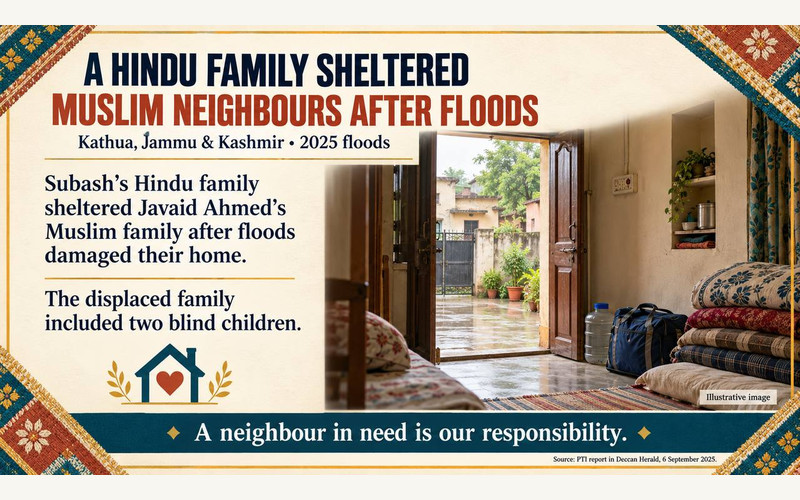
The Kathua story concerns a household rather than a large relief institution. After flooding damaged Javaid Ahmed's home in August 2025, Subash's Hindu family sheltered his Muslim family. The displaced family included two blind children. [4] Their circumstances make accessibility a relevant part of the story, but do not justify inventing details about specialised arrangements that the reporting does not establish.

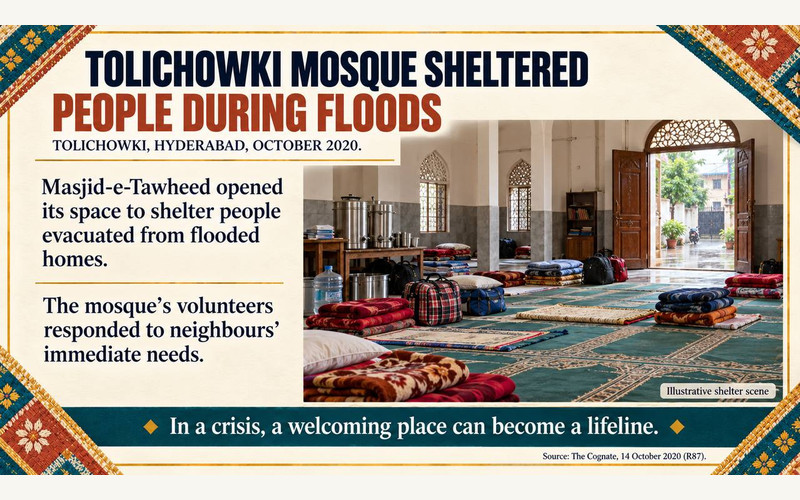
Masjid-e-Tawheed in Tolichowki, Hyderabad, sheltered people evacuated from flooded homes in October 2020, according to The Cognate's report of 14 October. [5] The mosque's volunteers responded to immediate needs. The account here stays with that specific shelter claim; it does not add an unsupported description of the religion or gender of every person accommodated.
Hospitality does not require identical beliefs
A building may have a distinctive religious purpose while also offering practical help to neighbours. Receiving shelter does not mean adopting the host's beliefs. Likewise, welcoming a person does not require erasing the host community's identity. The relevant civic principle is that need can be recognised across a difference that remains real.
This is why the gallery presents assistance in more than one direction. The examples include a mosque receiving Hindu families, a Hindu household receiving Muslim neighbours, and cooperation at a temple relief camp. These are not entries in a competition between communities. Read together, they make reciprocal care easier to imagine without claiming that every act must be repaid by the same people.
From an inspiring story to a practical question
Communities considering similar arrangements can ask who controls access to a building, how people will receive reliable information and how privacy and accessibility will be addressed. These are planning questions prompted by the stories, not claims that every reported shelter had the same facilities. A welcoming intention and a workable arrangement are related but different things.
Public authorities retain responsibilities for evacuation, relief and recovery. Local hospitality can complement those duties, especially where a familiar building or neighbour provides an immediate point of contact. The accounts do not show that voluntary action can replace a coordinated public response. They show something more specific: existing relationships and spaces can become useful when normal routines collapse.
For a visitor, the question extends beyond emergencies. Is there someone nearby whom you could approach without first navigating a religious boundary? Does a community institution have a relationship with its neighbours before assistance is needed? Ordinary contact cannot prevent every crisis, but it provides a setting in which requests and offers of help can be heard.
Important Distinction
These are dated reports of shelter and cooperation. They do not establish universal admission policies or verified totals beyond those explicitly reported.
Sources & Further Reading
1. How This Mosque Offered Shelter To Hindu Families After Kerala Floods. https://www.ndtv.com/kerala-news/how-this-mosque-gave-shelter-to-hindu-families-after-kerala-floods-1904666
2. Agartala: Hindus and Muslims join hands to help flood-hit residents | North East India News - The Indian Express. https://indianexpress.com/article/north-east-india/tripura/tripura-floods-communal-harmony-agartala-radhamadhab-temple-relief-camp-7978917/
3. Post stampede, compassion bridges faiths in Prayagraj | Lucknow News - The Times of India. https://timesofindia.indiatimes.com/city/lucknow/post-stampede-compassion-bridges-faiths-in-prayagraj/articleshow/117802348.cms
4. J&K Floods: Hindu Family Shelters Muslim Neighbours in Kathua After House Damage. https://www.deccanherald.com/india/jammu-and-kashmir/hindu-family-shelters-muslim-neighbours-after-floods-in-jammu-and-kashmirs-kathua-3714958
5. Hyderabad Mosque Shelters Citizens Evacuated From Their Flooded Homes. https://thecognate.com/hyderabad-mosque-shelters-citizens-evacuated-from-their-flooded-homes/
Related Topics
What makes contact across communities meaningful
Protecting neighbours and responding when lives are at risk
Care after the emergency from shared meals to rebuilding homes