
In Brief
Acts of protection interrupt the idea that a religious boundary must become a boundary of care. The gallery brings together neighbours who resisted violence and people who responded to fire or floods. These accounts concern identifiable people and particular events, rather than representative samples of entire communities. They invite attention to what assistance required: recognising danger, using available resources and treating another person's safety as a shared concern. A responsible reading also separates an exceptional rescue from advice that an untrained visitor should copy.
Detailed Story
Protection during communal violence
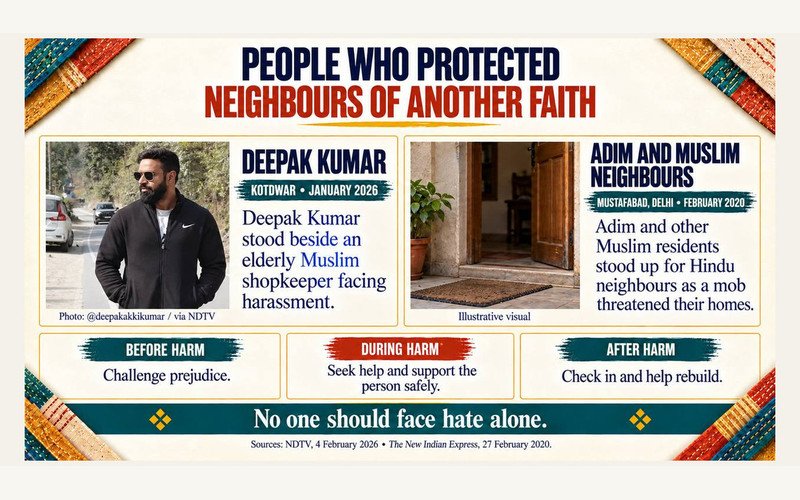
In Kotdwar in January 2026, Deepak Kumar defended a Muslim shopkeeper. Separately, reporting from Mustafabad in Delhi in February 2020 described Muslim residents protecting Hindu homes and local temples; Adim was among the residents who explained their determination to keep neighbours safe. [1,2] These accounts belong together because they show assistance crossing the boundaries that violence was seeking to enforce. They do not imply that every street was safe or that the wider violence should be remembered only through uplifting exceptions.
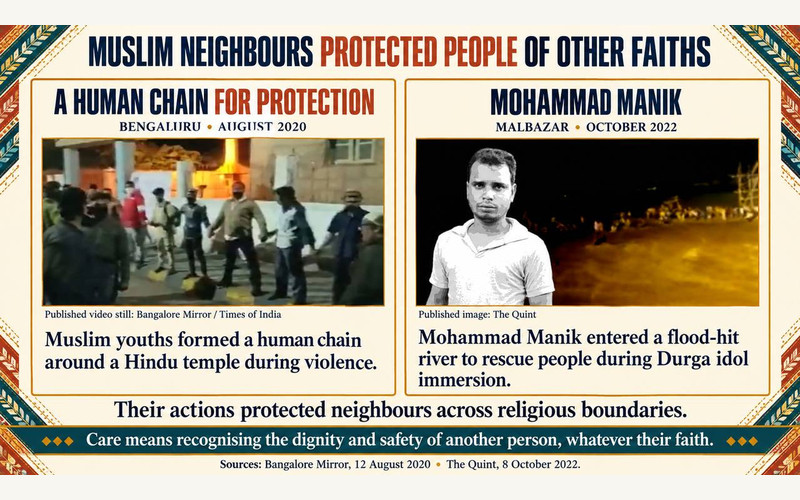
During violence in Bengaluru in August 2020, Muslim youths formed a human chain around a Hindu temple. [3] The act had a specific purpose in a dangerous setting. A photograph of that event can document participants and their position, but it cannot reveal every person's motives or establish what happened beyond the frame. Context, date and the accompanying report remain essential.
Rescue in a different setting
Mohammad Manik entered the flood-hit Mal river during Durga-immersion events in October 2022 to help people in danger. [4] The gallery deliberately avoids a disputed rescue total. Its point rests on the documented intervention, not on making the number as large as possible. Religious difference did not prevent a person from responding to other people's immediate danger.
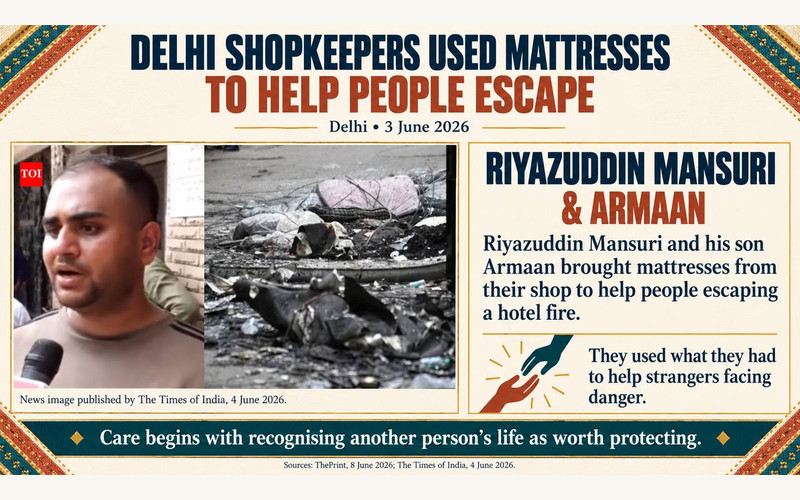
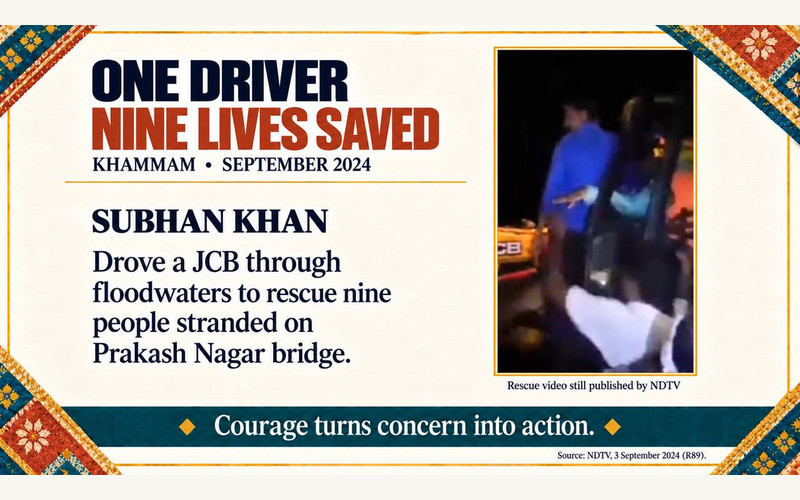
In Delhi's Malviya Nagar, Riyazuddin Mansuri and his son used mattresses from their shop during a fire on 3 June 2026. [5] In Khammam in September 2024, Subhan Khan drove a JCB through floodwater to bring back nine people stranded on Prakash Nagar bridge. [6] These are different emergencies, with different practical demands. Neither should be turned into a general instruction to jump from buildings or enter floodwater.
What an example can establish
A well-documented act of help refutes an absolute claim that people never assist those of another faith. It does not establish how common assistance is across a country. That wider question would require a different research design, including examples that received little publicity and situations in which help failed to arrive. Distinguishing these questions allows a story to remain meaningful without making it carry a claim it cannot support.
The same distinction protects people from being reduced to symbols. Someone who helped in an emergency remains an individual with a life beyond the incident. Their conduct need not prove the virtue of a religion, just as another individual's wrongdoing does not prove collective guilt. Public recognition can identify the action precisely without assigning the person responsibility for everyone who shares an identity.
Turning recognition into a civic habit
For readers, the practical question is which forms of assistance are realistic in ordinary life. Knowing neighbours, communicating accurate information and learning who can provide authorised help can all make cooperation easier to organise. These are proposals for community practice, not findings that every named rescuer followed a particular training programme.
Institutions also matter. Emergency access, fair policing and reliable public services affect whether people can obtain protection. Celebrating an individual's courage should not make preventable danger appear acceptable. The lasting civic lesson is to recognise another person's safety as a legitimate concern and to support conditions in which assistance does not depend entirely on an extraordinary act.
Important Distinction
A reported rescue is evidence of that event. It is neither a measure of a whole community's character nor a rescue-training guide.
Sources & Further Reading
1. When Deepak Kumar Became Muhammad Deepak To Defend Muslim Shopkeeper. https://www.ndtv.com/india-news/when-deepak-kumar-became-muhammad-deepak-to-defend-muslim-shopkeeper-10948133
2. Muslim neighbours protect Hindu residents in Mustafabad. https://www.newindianexpress.com/good-news/2020/Feb/27/delhi-riots-muslim-neighbours-brave-mob-wrath-to-save-hindus-in-minority-dominated-area-2109351.html
3. Vande Bharat: Bangalore Mirror caught up with some of the men to understand what happened when darkness fell. https://bangaloremirror.indiatimes.com/bangalore/cover-story/vande-bharatbangalore-mirror-caught-up-with-some-of-the-men-to-understand-what-happened-when-darkness-fell/articleshow/77513008.cms?prtpage=1
4. West Bengal: Muslim man jumps into flood-hit Mal river, saves 9 people from drowning | WATCH - APN News. https://apnlive.com/india-news/west-bengal-flood-mal-river/
5. Mattress seller seeks Rs 2 lakh compensation for helping in Delhi's Malviya Nagar fire incident | Delhi News - The Times of India. https://timesofindia.indiatimes.com/city/delhi/mattress-seller-seeks-rs-2-lakh-compensation-for-helping-in-malviya-nagar-fire-incident/articleshow/131509755.cms
6. Telangana Flood: If I Return...: Haryana Man's Bold Bulldozer Rescue In Telangana Floods. https://www.ndtv.com/india-news/telangana-flood-if-i-return-haryana-mans-bold-bulldozer-rescue-in-telangana-floods-6479380?pfrom=video-read
Related Topics
How fear becomes collective blame