
In Brief
A disaster's effects continue after the immediate rescue. The gallery follows volunteers cleaning flood-hit temples, workers organising food assistance, support for a bereaved family's travel and homes provided after the Wayanad landslides. These examples draw attention to recovery as a series of different needs rather than a single moment. Their numbers and dates must retain their scope: 51 homes describes a first phase reported in April 2026, and 14 Hindu recipient families is not a project-wide quota. Recognition is most useful when it keeps the actual work and its recipients visible.
Detailed Story
Restoring spaces and everyday routines
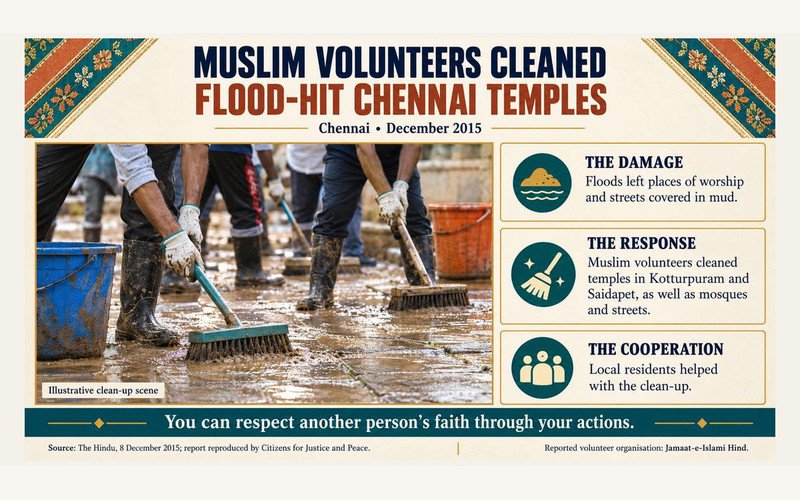
The gallery records Muslim volunteers cleaning flood-hit temples in Chennai in December 2015. [1] Cleaning was a practical contribution to restoring spaces used by other people. The point does not require claiming that every damaged building was restored or that one group carried out the whole recovery. A specific task can matter without becoming a complete account of a city's response.
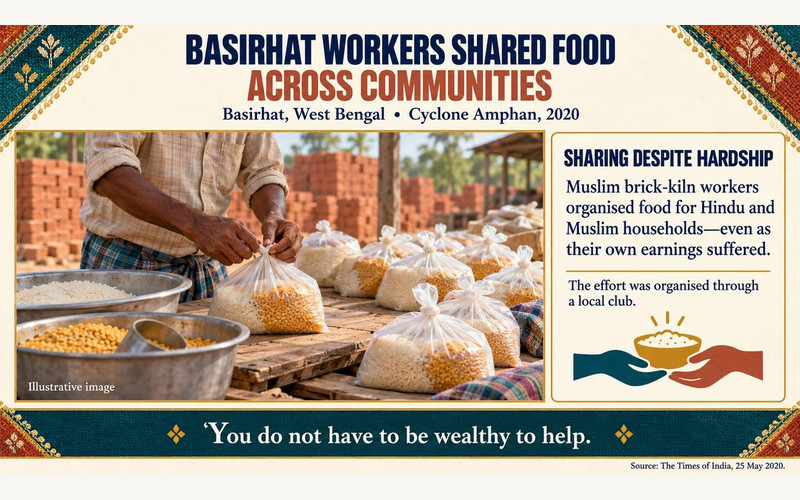
After Cyclone Amphan in 2020, members of Taragunia Orient Club in the Basirhat area pooled funds and sought further support for food relief. Many were casual brick-kiln workers, and reporting also described cooperation with kiln owners. [4] The account should therefore not be simplified into a claim that workers alone financed every meal. Shared effort is part of the story itself.
Housing after the Wayanad landslides
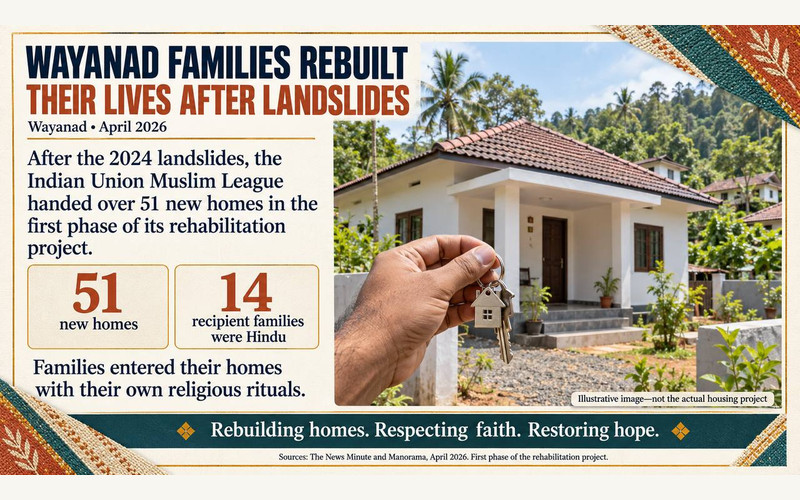
The News Minute reported that 51 families affected by the 2024 Wayanad landslides moved into homes built through the Indian Union Muslim League's rehabilitation initiative in April 2026. [2] This was a completed first phase, not the total number of homes promised or all rehabilitation in Wayanad. The event date should remain visible when the article is read in a later year.
Manorama's reporting identified 14 Hindu recipient families in that phase and described respect for families' own religious rituals. [3] These details support the gallery's example of assistance across faiths. They do not establish a quota, the religious composition of every beneficiary in later phases or a comprehensive evaluation of the organisation's work.
Recovery includes personal commitments
A household may need more than a replacement building. The gallery also includes the reported assistance to Ravi Rosan Kumar, whose airfare to take his mother's ashes to Bihar was arranged by SYS Santhwanam after the landslides. [5] This separate story concerns a particular family commitment. It should not be conflated with the housing project or presented as evidence that the same organisation delivered both kinds of support.
Placed together, these accounts show why recovery is not well described by one photograph or one total. Food, usable spaces, housing and family obligations concern different aspects of everyday life. The examples do not quantify their relative importance. They invite readers to notice needs that may receive less attention once the emergency itself has left the headlines.
Assessing help with fair questions
Readers can ask what was completed, when it became usable and who the stated figures describe. A promised house is different from a finished house, and a finished house is different from one into which a family can move. The April 2026 report specifically described families moving into homes. Precision about that stage makes the achievement clearer without exaggerating it.
Similar care applies to recognising contributors. An organisation, workers, donors and public bodies may have different roles. Naming one documented contribution should not erase the others or imply that every wider claim about an institution has been verified. A positive example remains credible when its limits are stated alongside the achievement.
For visitors, the practical invitation is to see service as something that can continue beyond a dramatic rescue. A community can remain attentive to needs, ask recipients what is useful and follow through on a defined commitment. These are civic possibilities suggested by the accounts, not a claim that every volunteer programme works equally well. The value lies in sustained attention to people rebuilding ordinary lives.
Important Distinction
First-phase achievements are not project-wide totals. Promises, completed construction and actual occupancy describe different stages of recovery.
Sources & Further Reading
1. Muslim group cleans flood-hit temples | CJP. https://cjp.org.in/muslim-group-cleans-flood-hit-temples/
2. Wayanad rehabilitation: 51 families move into houses constructed by IUML. https://www.thenewsminute.com/kerala/wayanad-rehabilitation-51-families-move-into-houses-constructed-by-iuml
3. Transparency sets IUML homes apart. https://www.onmanorama.com/videos/news/kerala-news/2026/04/28/transparency-sets-iuml-homes-apart-wayanad-landslides-meppadi-rehabilitation-project.html
4. Muslim youths stand by one & all in cyclone-hit Basirhat village | Kolkata News - Times of India. https://timesofindia.indiatimes.com/city/kolkata/muslim-youths-stand-by-one-all-in-cyclone-hit-basirhat-village/amp_articleshow/75957684.cms
5. Wayanad disaster: Muslim organization comes to Hindu family’s aid | Kochi News - Times of India. https://timesofindia.indiatimes.com/city/kochi/wayanad-landslides-muslim-organization-comes-to-hindu-familys-aid/articleshow/112253999.cms
Related Topics
The human and economic costs of exclusion