
In Brief
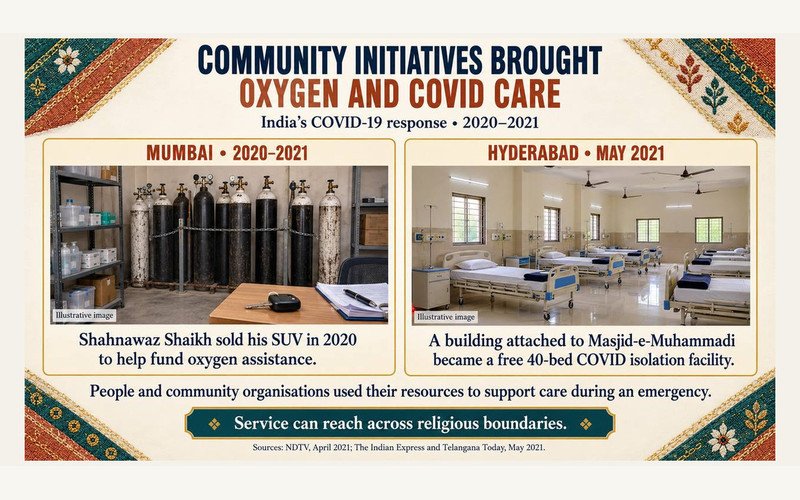
The gallery's health-related stories concern people and institutions making resources available during periods of need. Shahnawaz Shaikh supported oxygen assistance in Mumbai; an attached mosque building became a COVID isolation centre in Hyderabad; and a temple priest attended a blood-donation camp at a mosque. Each example has its own date, organisation and scope. Together they illustrate cooperation around a practical purpose without claiming that goodwill alone provides clinical expertise or that reported assistance establishes a measured number of lives saved.
Detailed Story
Reading the pandemic examples accurately
An April 2021 NDTV report described Shahnawaz Shaikh selling his SUV the previous year to support an oxygen-assistance scheme. [1] The sale therefore belongs to 2020, even though the account appeared during the following year's emergency. This small chronological distinction matters: repeating the publication year as the date of every action would change the story.
In Hyderabad in May 2021, a two-storey building attached to Masjid-e-Muhammadi became a 40-bed COVID isolation centre. [2] The distinction between an attached building and a prayer hall is worth preserving. It identifies the actual space described by the report and avoids turning a specific local arrangement into an imagined scene. The bed count records reported capacity, not the number of patients treated or a clinical outcome.
A shared public purpose at a mosque
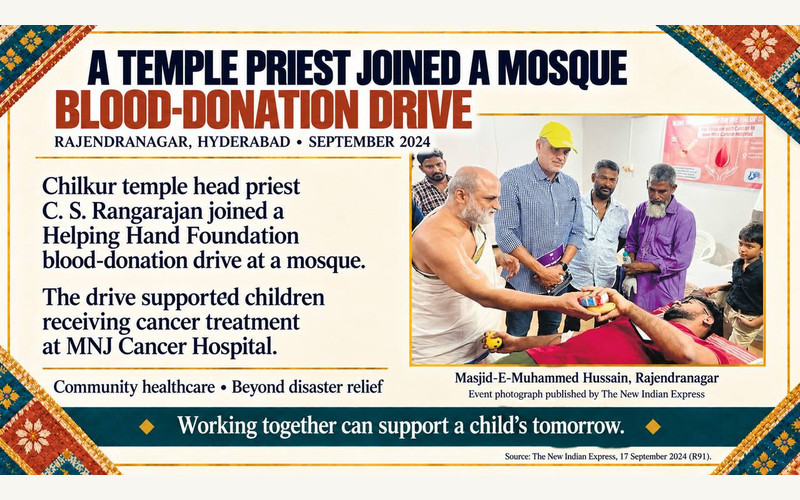
In September 2024, Chilkur temple priest CS Rangarajan attended a Helping Hand Foundation blood-donation camp at Masjid-e-Muhammed Hussain in Rajendranagar, Hyderabad. Reporting connected the initiative with support for children receiving treatment at MNJ. [3] The gallery does not add an unverified daily requirement or use attendance to imply that every participant donated.
The setting is significant because cooperation occurred through an activity with a practical recipient and an identifiable organiser. A visitor need not interpret the event as agreement on every religious question. Participants could retain different beliefs while recognising the value of a shared contribution. That is a more precise meaning of interfaith cooperation than a claim that all differences disappeared.
Resources and expertise have different roles
The examples involve money, buildings, organising capacity and public participation. These resources can help an initiative function, but the reports are not medical studies evaluating treatment effectiveness. A count of beds or a photograph of a camp cannot answer questions about clinical outcomes. Those would require appropriate medical records and analysis.
For the same reason, this article does not provide treatment instructions or donor-eligibility advice. Its subject is civic cooperation. Decisions about an individual's care or participation belong with the relevant qualified service. A community's useful contribution may be to connect people with that service, support its authorised work or make a suitable space available under the applicable arrangements.
How to recognise meaningful cooperation
One useful question is whether an initiative names the need it intends to meet. Another is whether the organisation responsible can explain what happened and what remains necessary. These questions keep attention on recipients rather than on the public image of helpers. They are an editorial framework for reading the examples, not an assertion that all three initiatives were independently audited.
A second question concerns continuity. A widely shared image can draw attention to an event, but an enduring relationship involves more than a single appearance. Neighbours can ask how institutions communicate, whether people know where to seek help and whether a partnership continues when publicity fades. The gallery's stories open that discussion; they do not supply a universal model.
The larger lesson is that religious identity need not prevent institutions from collaborating around a concrete human need. Public systems, professional services and community initiatives have different responsibilities. Recognising those differences allows voluntary effort to be appreciated accurately while keeping the needs of patients and families at the centre of the account.
Important Distinction
Capacity, participation and assistance are not clinical outcomes. These reports support the stated activities, not an unverified tally of lives saved.
Sources & Further Reading
1. Shahnawaz Shaikh Sold His SUV Last Year To Start Oxygen Supply Scheme. It's Saving Lives. https://www.ndtv.com/offbeat/shahnawaz-shaikh-the-mumbai-man-who-sold-his-suv-to-start-free-oxygen-supply-scheme-2419444
2. Hyderabad: Mosque turns into Covid care centre | Hyderabad News - The Indian Express. https://indianexpress.com/article/cities/hyderabad/hyderabad-mosque-turns-into-covid-care-centre-7329196/
3. Telangana: Chilkur priest attends blood donation camp in mosque on Milad-un-Nabi. https://www.newindianexpress.com/states/telangana/2024/Sep/17/telangana-chilkur-priest-attends-blood-donation-camp-in-mosque-on-milad-un-nabi
Related Topics
Interfaith dialogue and the institutions that sustain it