
In Brief
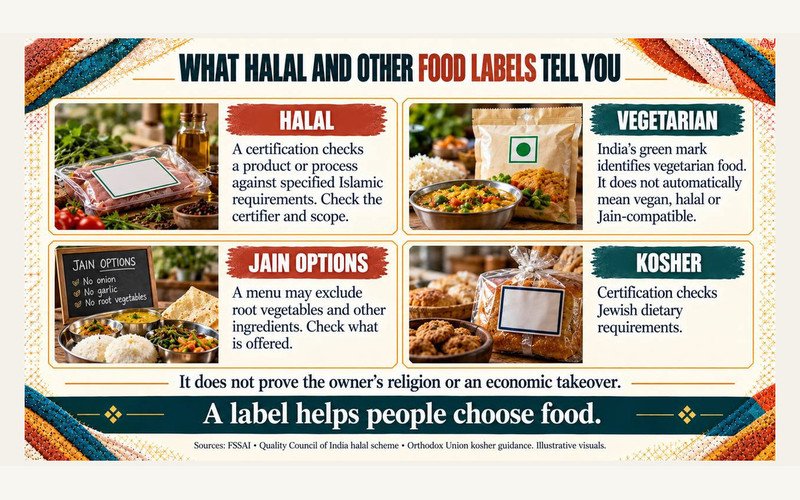
Halal means permissible within Islamic teaching. In food, it concerns ingredients and preparation; commercial certification is a system for checking specified requirements. A halal label is not evidence of a political project, and halal food is not limited to meat. Vegetarian, vegan, Jain and kosher preferences answer different questions and should not be treated as interchangeable. Consumers benefit from accurate labelling and clear information about ingredients, processing and certification. Respecting a person's dietary choice does not require adopting that person's religious beliefs.
Detailed Story
A religious category and a commercial label
The Qur'an discusses permitted food and identifies prohibitions, including carrion, blood and pork in 5:3. [1] Halal is a broader ethical category than a food logo: it can describe whether an action or transaction is permissible. In everyday food shopping, however, the word usually signals that particular ingredients and methods are considered acceptable under Islamic dietary rules.
Religious teaching, interpretation and certification are distinct. Scholars may differ over particular ingredients or processes. A certification body translates selected requirements into an inspection or assurance system. A consumer may rely on certification, personal knowledge or a trusted supplier. None of these arrangements means that every Muslim eats in exactly the same way.
Why certification exists
Modern food production can involve ingredients and processing aids whose origins are not obvious from the finished product. Certification can help consumers assess a defined set of requirements across a supply chain. Its usefulness depends on what standard is applied, who audits compliance and what products the certificate actually covers.
India's Quality Council of India operates the India Conformity Assessment Scheme for Halal, or i-CAS Halal, associated with halal meat and meat products for export. [2] This particular scheme should not be confused with every private halal mark on domestic products. A claim about the scope of one certification programme does not establish the legal status of all labels or products across India.
Labels answer different questions
A vegetarian label principally identifies a category of ingredients under the relevant food-labelling rules. A vegan claim concerns the exclusion of animal-derived ingredients according to its applicable requirements. Neither automatically establishes compliance with a religious dietary code. Milk illustrates the distinction: it can be vegetarian without being vegan.
India's Food Safety and Standards Authority prescribes vegetarian and non-vegetarian declarations. These are regulatory categories, not declarations that a product is spiritually acceptable to every consumer. [3] A person with an allergy also needs allergen information; a religious label is not a replacement for it.
Kosher food follows Jewish dietary law. Among its distinctive requirements is the separation of meat and dairy, explained by the Orthodox Union's kosher guidance. [4] Halal and kosher requirements overlap in some respects but are not identical. A customer should therefore ask which standard is relevant rather than assuming that either word guarantees the other. Jain food choices likewise reflect a particular religious concern with avoiding harm and cannot be reduced to an interchangeable branding term.
Food practices are widespread and diverse
Pew Research Center's 2019–2020 survey found that 81% of Indian adults limited meat in at least one way; 39% described themselves as vegetarian. The first category included several practices, such as avoiding particular meats or abstaining on particular days. [5] It did not mean that 81% were vegetarian.
These findings show why a menu or label can be useful without becoming a statement about who belongs. In a shared canteen, clear ingredients, separate serving utensils where needed and understandable options can help people eat together. A label offers information; people retain the ability to choose a different product.
Investigate commercial allegations as commercial allegations
A claim about mislabelling, certification fees, contamination or financial wrongdoing should identify a specific organisation, practice and evidence. It can then be investigated through the relevant regulatory and legal processes. The existence of a religious food preference does not establish such wrongdoing.
Equally, respect for belief does not put commercial claims beyond scrutiny. Consumers can ask who issued a certificate, when it expires and what it covers. The fair principle is consistent: verify the specific claim, distinguish food safety from religious compliance, and avoid transferring suspicion from one business to an entire community.
Facts & Figures
Pew's survey fieldwork took place in 2019–2020; its food findings were published in 2021. [5]
81% of surveyed Indian adults restricted meat in at least one way; 39% identified as vegetarian. [5]
Qur'an 5:3 is a primary passage concerning prohibited foods. [1]
Important Distinction
Halal is not synonymous with meat, vegetarian is not synonymous with vegan, and certification is not the same as religious belief. Always ask which question a label answers.
Sources & Further Reading
1. Qur'an, Surah al-Ma'idah 5:3; Arabic text and identified translations. https://quran.com/5/3
2. Quality Council of India. India Conformity Assessment Scheme for Halal, scheme portal and guidance. https://i-cas-halal.qcin.org/
3. Food Safety and Standards Authority of India. Guidance Note on Labelling of Food, 2022. https://www.fssai.gov.in/upload/uploadfiles/files/Guidance_Note_Labelling_23_02_2022.pdf
4. Orthodox Union. The Kosher Primer, undated institutional guidance. https://oukosher.org/the-kosher-primer/
5. Pew Research Center. Religion and food, 29 June 2021. https://www.pewresearch.org/religion/2021/06/29/religion-and-food/
Related Topics
Checking fabricated claims distorted facts and false context