
In Brief
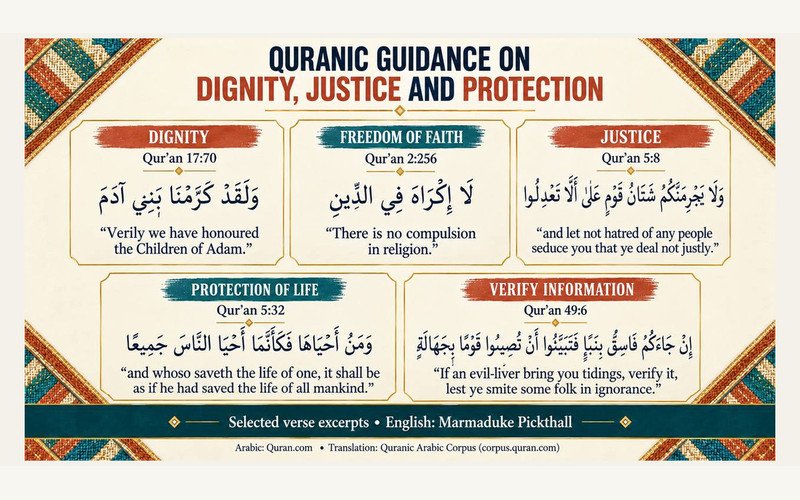
The gallery highlights five Qur'anic passages concerning human dignity, freedom from religious compulsion, justice the gravity of killing and verifying information. These are religious teachings, not scientific findings or a complete account of every Muslim society. Their wording, addressees and interpretive contexts matter. Reading them carefully reveals ethical resources that Muslims bring to public life while avoiding the claim that all believers interpret or apply them identically. A respectful account explains the text and its significance without turning selected verses into proof that historical practice has always matched the ideal.
Detailed Story
Begin with text and context
Muslims understand the Qur'an as revelation. Academic and public interpretation also asks about language, literary setting, historical reception and the difference between a text and its application. Translation adds another layer: an English rendering is an interpretation of Arabic expressions, not a replacement for the original.
The five passages selected by the gallery form an ethical introduction. They are not an exhaustive legal code and should not be detached from surrounding verses. The explanations below paraphrase their central ideas rather than presenting a composite quotation.
Human dignity: 17:70
Surah al-Isra 17:70 speaks of God's honouring the children of Adam and providing them with sustenance and capacities. [1] Its reference to humanity offers a basis for discussing dignity beyond the boundaries of a single community. It does not say that dignity must first be earned through wealth, nationality or public achievement.
The ethical implication is significant for everyday interaction: a person's identity should not make humiliation acceptable. That implication is an interpretation drawn from the passage, not a claim that the verse uses the vocabulary of a modern constitution. Religious and constitutional arguments can converge on respectful treatment while remaining different kinds of argument.
Religious compulsion: 2:256
Surah al-Baqarah 2:256 rejects compulsion in religion. [2] It is central to contemporary Muslim discussions of conscience. Interpreters have debated its historical setting, scope and relationship to other texts and legal traditions. Citing the verse therefore should not erase the complexity of Islamic legal history.
For this gallery's purpose, it provides a clear scriptural basis for discussing the difference between persuasion and force. The sincerity of belief cannot simply be established by an outward act compelled by another person. How that principle relates to particular legal questions requires interpretation; it should not be asserted through a slogan alone.
Justice despite hostility: 5:8
Surah al-Ma'idah 5:8 directs believers to uphold justice and warns against allowing hostility towards a people to lead to injustice. [3] The demanding part of the teaching is its application when sympathy is absent. Fairness towards friends is easier than fairness towards those one fears or dislikes.
This offers a useful ethical test for public disputes: would the same standard of evidence be applied if the accused belonged to one's own community? The verse addresses moral conduct; it is not evidence that any particular modern accusation is true or false. That remains a matter for investigation.
The gravity of taking life: 5:32
Surah al-Ma'idah 5:32 states a prescription for the Children of Israel, linking the killing of a person, with specified exceptions concerning murder and corruption in the land, to the gravity of killing humanity, and saving a life to saving humanity. [4] The preceding narrative concerns the two sons of Adam.
Popular quotations often omit the addressee and qualifications. Retaining them makes the account more accurate without losing the verse's powerful emphasis on life. The passage's exceptions must not be converted into permission for private individuals to label opponents and attack them. Questions of law, interpretation and legitimate authority cannot be bypassed by extracting a phrase.
Ideals and conduct are different evidence
These passages help explain why Muslims may understand justice and protection of others as religious responsibilities. They do not establish that every Muslim government, institution or individual has acted accordingly. Ethical traditions can inspire conduct and also provide standards by which conduct is criticised. Keeping that distinction visible makes interfaith learning more honest and more useful.
Verify information before causing harm
Surah al-Hujurat 49:6 directs believers to investigate information brought by an unreliable person, so that people are not harmed through ignorance and regret follows. [5] This is a scriptural principle; modern verification also requires checking the actual evidence. The approved panel identifies Marmaduke Pickthall as its English translator. This article paraphrases the passages rather than presenting a new composite translation.
Important Distinction
Scriptural teaching, scholarly interpretation, state law and individual behaviour are different subjects. A religious ideal neither proves nor excuses what a particular actor has done.
Sources & Further Reading
1. Qur'an. Surah al-Isra, 17:70; Arabic and identified translations. https://quran.com/17/70
2. Qur'an. Surah al-Baqarah, 2:256; Arabic and identified translations. https://quran.com/2/256
3. Qur'an. Surah al-Ma'idah, 5:8; Arabic and identified translations. https://quran.com/5/8
4. Qur'an. Surah al-Ma'idah, 5:32; read with 5:27–34. https://quran.com/5/32
5. Qur’an. Surah al-Hujurat, 49:6, Arabic and identified translations. https://quran.com/49/6
Related Topics
Freedom of conscience and claims about conversion